
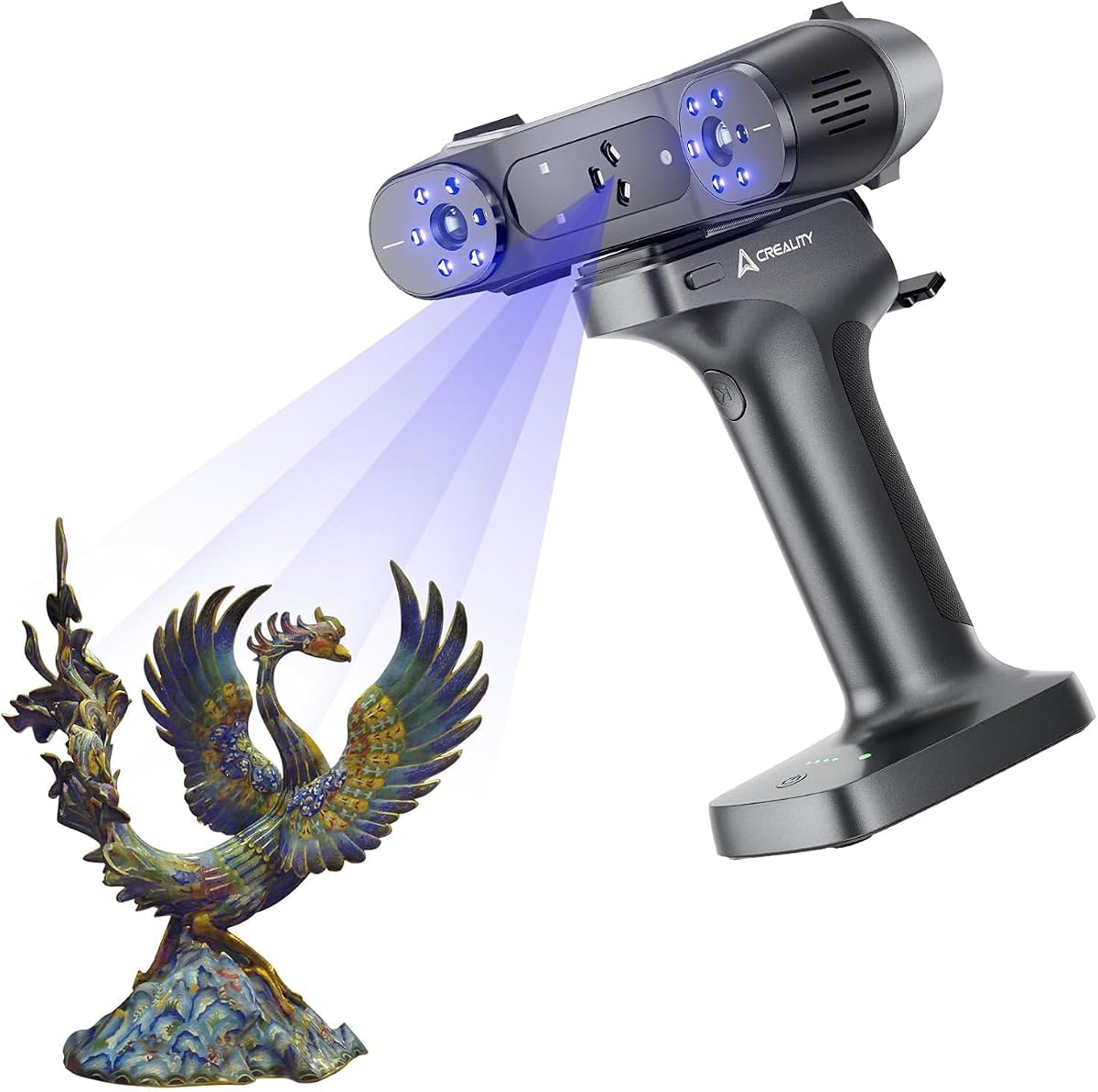
Creality Otter Lite Basic
5.0Editor score
0.05mm high precision resolution
Dual-mode close and long range
Portable plug and play design
Discover the top 3D scanners for reverse engineering in October 2026. This guide compares precision, speed, and features to help you choose the best device.
Reverse engineering requires tools that capture geometry with extreme accuracy. A good 3D scanner must handle complex shapes, dark materials, and varying lighting conditions to ensure reliable data for CAD reconstruction and analysis.
We evaluated ten leading models based on their scanning modes, precision specs, software ecosystems, and real-world usability. Our comparison focuses on features that matter most to engineers and designers working on industrial parts and prototypes.
Each pick highlights key strengths and ideal use cases to guide your decision. Prices and availability change frequently, so verify current details before purchasing to ensure you get the best value for your specific workflow needs.
5.0Editor score


This side-by-side comparison highlights the core specifications and capabilities of each model. We focus on accuracy, scanning modes, and software compatibility to help you find the right fit for your reverse engineering projects.



The Revopoint MetroX Pro stands out as a top-tier tool for reverse engineering due to its industrial-grade blue laser scanning. It delivers single-frame precision of up to 0.01mm and accuracy up to 0.02mm, making it reliable for tight tolerance tasks.
We may earn a commission when you buy through this link, at no additional cost to you.
Its ability to scan shiny or dark surfaces without spray is a major time saver. The device offers four scanning modes including cross-line lasers and full-field structured light, allowing you to adapt to different object geometries quickly and efficiently.
While the hardware is robust, the full potential requires Revo Design or Revo Measure software which are sold separately. This adds to the total cost but provides the necessary tools for converting scan data into usable CAD models.
For professionals needing high precision without the hassle of surface preparation, the MetroX Pro is an excellent investment. It balances speed and accuracy well, making it suitable for engineering inspections and prototyping workflows.
The volumetric accuracy of 0.02mm plus 0.04mm times length ensures consistent results across larger parts, essential for quality control.
Streaming scan data to a mobile device lets you walk around the object freely while keeping an eye on progress from a screen.
We may earn a commission when you buy through this link, at no additional cost to you.
The MetroY Ultra brings impressive speed with up to 90 FPS on supported GPUs. This makes it ideal for large objects where scan time matters, without sacrificing the 0.015mm volumetric accuracy needed for reverse engineering tasks.
We may earn a commission when you buy through this link, at no additional cost to you.
Its outdoor capability is a standout feature, allowing work in environments with up to 100,000 lux. This flexibility is crucial for inspecting parts outside the controlled lab setting or on a factory floor.
The wireless experience via Wi-Fi 6 and a long-lasting battery grip enhances portability. However, the high performance comes at a cost, and maximizing speed requires a powerful NVIDIA GPU which may not be standard.
If you need to scan large industrial components quickly and accurately in varied lighting, the MetroY Ultra delivers. It reduces data acquisition time significantly while maintaining quality for engineering analysis.
Powerful laser modes allow consistent scanning even in harsh sunlight which typically interferes with structured light devices.
Rapid frame rates mean less time holding the scanner steady, reducing user fatigue during long inspection sessions.
We may earn a commission when you buy through this link, at no additional cost to you.
The EinScan Rigil offers a truly wireless all-in-one experience with onboard computing. You can scan standalone without a PC connected which provides unmatched freedom for inspecting parts in hard-to-reach locations or field sites.
We may earn a commission when you buy through this link, at no additional cost to you.
Its hybrid light source combines blue laser and IR VCSEL to handle dark or reflective surfaces effectively. The 5MP camera captures vibrant textures while the 0.04mm accuracy ensures enough detail for detailed reverse engineering workflows.
The device includes a 6.4 inch 2K AMOLED touchscreen and powerful internal hardware like 32GB RAM. This means processing happens locally which speeds up the workflow but adds weight to the handheld unit.
For teams that value mobility above all else, the Rigil is a strong choice. It combines professional grade scanning with true portability, making complex tasks easier when cables are not an option.
Processing data directly on the scanner removes the bottleneck of transferring large point clouds to a separate machine.
Advanced algorithms allow direct scanning of black or shiny metal parts without needing to apply markers or spray.
We may earn a commission when you buy through this link, at no additional cost to you.
The Raptor Pro is designed for versatility with scanning modes that handle objects from 5mm to 4000mm. This adaptability makes it suitable for everything from small mechanical parts to large automotive components in one workflow.
We may earn a commission when you buy through this link, at no additional cost to you.
It uses a mix of blue lasers and infrared structured light to capture details quickly. The temperature compensation algorithm ensures stability in varying thermal conditions which is important for industrial environments where heat fluctuates.
True color rendering and software compatibility with major tools like SolidWorks enhance its utility. You can get detailed surface data ready for CAD integration without excessive post processing steps or manual adjustments.
If you need a single scanner for mixed project sizes, the Raptor Pro offers excellent range. It balances speed and detail well and fits well in engineering shops that work on diverse prototypes.
Switching between close range and large area modes on the fly makes this scanner flexible for different job types.
Infrared matching helps with feature rich objects that might struggle with standard structured light alone.
We may earn a commission when you buy through this link, at no additional cost to you.
The INSPIRE 2 is built for portability weighing just 190g while maintaining solid performance. Its infrared structured light and laser modes let you scan reflective or dark surfaces without spray which simplifies on-site work.
We may earn a commission when you buy through this link, at no additional cost to you.
It supports outdoor scanning in lighting up to 20,000 lux and includes optical zoom to focus on specific details. This makes it great for heritage preservation or field inspections where carrying a heavy device is impractical.
The accuracy of up to 0.05mm is good for many reverse engineering tasks though not as tight as industrial lab scanners. The software ecosystem allows easy export to CAD tools for further analysis and design work.
For professionals who need a mobile tool for quick measurements, the INSPIRE 2 is a practical choice. It reduces the burden of setup and transport while delivering reliable data for many engineering needs.
The light weight allows you to hold the scanner for long periods without hand fatigue during detailed inspection sessions.
Outdoor filters and high lux tolerance ensure the scanner works even in bright environments where others fail.
We may earn a commission when you buy through this link, at no additional cost to you.
The Otter Lite Basic offers a great entry point into reverse engineering with 0.05mm resolution at a competitive price. It supports both close and long range scanning so you can handle different object sizes with one device.
We may earn a commission when you buy through this link, at no additional cost to you.
With a 30 fps capture rate and true color mapping, it delivers usable data for prototyping and repair work. The portable design and included accessories like markers and a case make it ready to use out of the box.
While it may not match the speed of top-tier industrial scanners, it is sufficient for many small to medium projects. The software is user-friendly and compatible with both Windows and Mac which adds to its appeal.
For students or small teams starting with reverse engineering, the Otter Lite Basic provides value without sacrificing essential precision. It is a reliable workhorse for learning and everyday scanning tasks.
The low price point allows more teams to access digital scanning technology without a large upfront investment.
Intuitive controls and LED feedback guide you to the right distance so scans start quickly without frustration.
We may earn a commission when you buy through this link, at no additional cost to you.
The standard MetroX Pro shares many core strengths with the advanced model. It offers industrial-grade accuracy and four scanning modes that make it capable for various reverse engineering needs including feature tracking and turntable automation.
We may earn a commission when you buy through this link, at no additional cost to you.
Its blue laser technology captures flat and shiny surfaces efficiently without extra prep. This reliability is key for quality inspection tasks where data consistency matters more than raw speed.
Software compatibility allows seamless transfer to tools like Revo Measure for analysis. While the standard version may lack some advanced extras, it still provides a robust foundation for professional workflows.
For users who need precise measurements and are comfortable with basic software setups, this is a solid choice. It delivers high value by focusing on the essential features that drive accurate results.
One-click turntable scans reduce manual effort when dealing with complex rotational objects that need full coverage.
Industrial grade laser specs ensure consistent data capture across multiple sessions and different object types.
We may earn a commission when you buy through this link, at no additional cost to you.
This Raptor Pro model focuses on metrology grade accuracy with a volume accuracy of 0.02mm plus 0.08mm per meter. It is built for tasks where dimensional correctness is critical for reverse engineering and quality control.
We may earn a commission when you buy through this link, at no additional cost to you.
Its 660,000 points per second rate ensures fast data capture which is vital for large or complex assemblies. The outdoor readiness means you can trust it even in non lab environments without fear of lighting interference.
The included software provides step-by-step tutorials and editing tools that simplify the workflow. This helps users of various skill levels produce high quality models without extensive training or trial and error.
If precision and speed are your top priorities, this scanner delivers. It balances technical power with usability, making it a strong tool for serious engineers and designers.
Volume accuracy figures ensure that even long parts maintain tight tolerances during reconstruction tasks.
High point rates reduce the time needed to scan large surface areas while maintaining detail integrity.
We may earn a commission when you buy through this link, at no additional cost to you.
The Raptor X combines a strong laser array with wireless freedom via WiFi 6. This allows quick data transmission and real time monitoring on phones without needing to plug in during long sessions.
We may earn a commission when you buy through this link, at no additional cost to you.
Its large 35400mWh battery supports extended use which is ideal for field work. The 0.02mm accuracy ensures reliable capture of fine details on engineering parts and molds without needing marker alignment.
Anti-shake technology helps maintain tracking even if your hand moves slightly. This stability makes scanning smoother and reduces the need for retakes which saves time during large scale projects.
For those needing a balance of wireless convenience and high accuracy, the Raptor X fits well. It is a powerful tool for professionals who need flexibility without compromising data quality.
Lossless compression ensures data arrives intact at high speeds so you never lose quality during transfer.
Extended battery allows continuous operation throughout the day without frequent charging interruptions.
We may earn a commission when you buy through this link, at no additional cost to you.
This Raptor Pro model offers 0.02mm metrology grade accuracy with upgraded dual blue laser modes. It handles large objects efficiently while capturing fine edges with 0.1mm lines for rich detail in engineering parts.
We may earn a commission when you buy through this link, at no additional cost to you.
NIR structured light with speckle matching allows direct scanning of feature-rich workpieces without markers. The face and body mode adds versatility, enabling quick human scans in minutes for medical or design projects.
Software integration supports stitching and adjustable resolution for seamless 360 degree scans. This flexibility ensures you can tailor settings to your specific project needs from fine details to large assemblies.
If you need a top-tier tool for automotive or industrial reverse engineering, this scanner is robust. It combines precision with workflow flexibility, making it a worthy investment for demanding tasks.
Crossed lines cover large areas quickly while parallel lines focus on edges for precise geometric extraction.
NIR light handles complex surfaces that might confuse standard scanners so you get better overall shape data.
We may earn a commission when you buy through this link, at no additional cost to you.
Choosing the right scanner involves balancing precision, speed, and software needs for your specific workflow.
For reverse engineering, accuracy is the most critical metric. Look for single-frame precision of 0.01mm to 0.05mm depending on part complexity. Volumetric accuracy also matters for larger objects to ensure consistent dimensions across the model.
Prioritize scanners with metrology grade specs if you are working on tight tolerance parts.
Multiple scanning modes allow you to adapt to different shapes. Cross-line lasers are fast for flat parts while single-line or parallel lines capture deep holes or fine edges. Full-field structured light is best for detailed textures.
Choose a model with versatile modes to handle a variety of part geometries without extra tools.
Many industrial parts have dark or shiny surfaces that confuse cameras. Scanners using blue laser or infrared structured light can scan these directly without spray which saves time and preserves part integrity.
Look for devices that explicitly state no spray is needed for reflective materials.
If you work in multiple locations or on large assemblies, wireless capability is a major benefit. Wi-Fi 6 streaming allows you to monitor scans on mobile devices and move freely without cable drag.
Battery life should also be sufficient for field work to avoid interruptions during critical scanning sessions.
The hardware is only part of the equation. Check if the software supports your CAD tools and allows easy export of STL, OBJ, or PLY files. Some manufacturers sell advanced software separately so factor in that cost.
Integrated solutions that offer auto-turntable support or cloud storage can speed up your workflow significantly.
Structured light scanners are sensitive to ambient light. If you need to work outdoors or in bright environments, choose a model with laser modes or outdoor filters that can handle high lux levels.
Outdoor readiness ensures your scanner remains reliable even in non lab settings.
High-resolution scans generate large data files that need processing power. Ensure your PC has a dedicated GPU, ample RAM, and a modern CPU to handle point cloud editing smoothly.
Check system requirements before buying to avoid bottlenecks when working with dense scan data.
Entry-level scanners offer great value for hobbyists and small projects while industrial models cost more but provide higher accuracy and durability. Assess your actual needs to avoid overpaying for features you won't use.
Consider total cost of ownership including software licenses and accessories when setting your budget.
Before scanning, clean the object surface and remove any dust or oils that might confuse the sensor. If using markers place them evenly on flat areas to help the software track movement accurately.
During scanning, move the device at a steady pace and keep it within the recommended distance range. For large parts scan in sections and overlap them so the software can stitch the point cloud together correctly.
Store the scanner in its protective case when not in use to avoid drops or dust buildup. Clean lenses with a soft cloth and avoid exposing the device to extreme temperatures or humidity.
Not necessarily. Many modern scanners using blue laser or infrared technology can handle shiny or dark surfaces without spray. This saves time and prevents mess on sensitive parts. Check if your specific model supports no-spray scanning.
Yes but it depends on the model. Scanners with powerful lasers or outdoor modes can handle bright sunlight up to 100,000 lux. Others may need a shaded area or filters to work accurately outside. Always check the lighting specs.
You typically need software that can convert point clouds into CAD models. Options include Revo Design, Geomagic, or SolidWorks. Some scanners offer basic software included but advanced editing may require a paid license.
Handheld scanners can reach up to 0.01mm single-frame precision for industrial models. Accuracy depends on the environment and object size. For tight tolerances look for metrology-grade devices with verified volumetric accuracy.
Common formats include STL, OBJ, PLY, and ASC. These allow easy export to most CAD or 3D printing software. Check compatibility with your workflow to ensure you can move data smoothly between tools.
Yes. Some scanners offer full-size modes covering objects up to 4000mm. Use cross-line lasers for large areas and infrared for detailed parts. Stitching multiple scans together may be required for full coverage.
The Revopoint MetroX Pro stands out as our top pick for its balance of speed and precision. For budget buyers the Creality Otter Lite Basic offers solid accuracy while the EinScan Rigil provides unmatched wireless freedom.
When selecting a scanner consider the types of parts you scan most. If you work with dark or large objects prioritize laser technology and outdoor modes to ensure reliable data.
Prices and features change often so always verify current specifications before making a purchase. Choosing the right tool for your workflow will save time and improve the quality of your reverse engineering results.