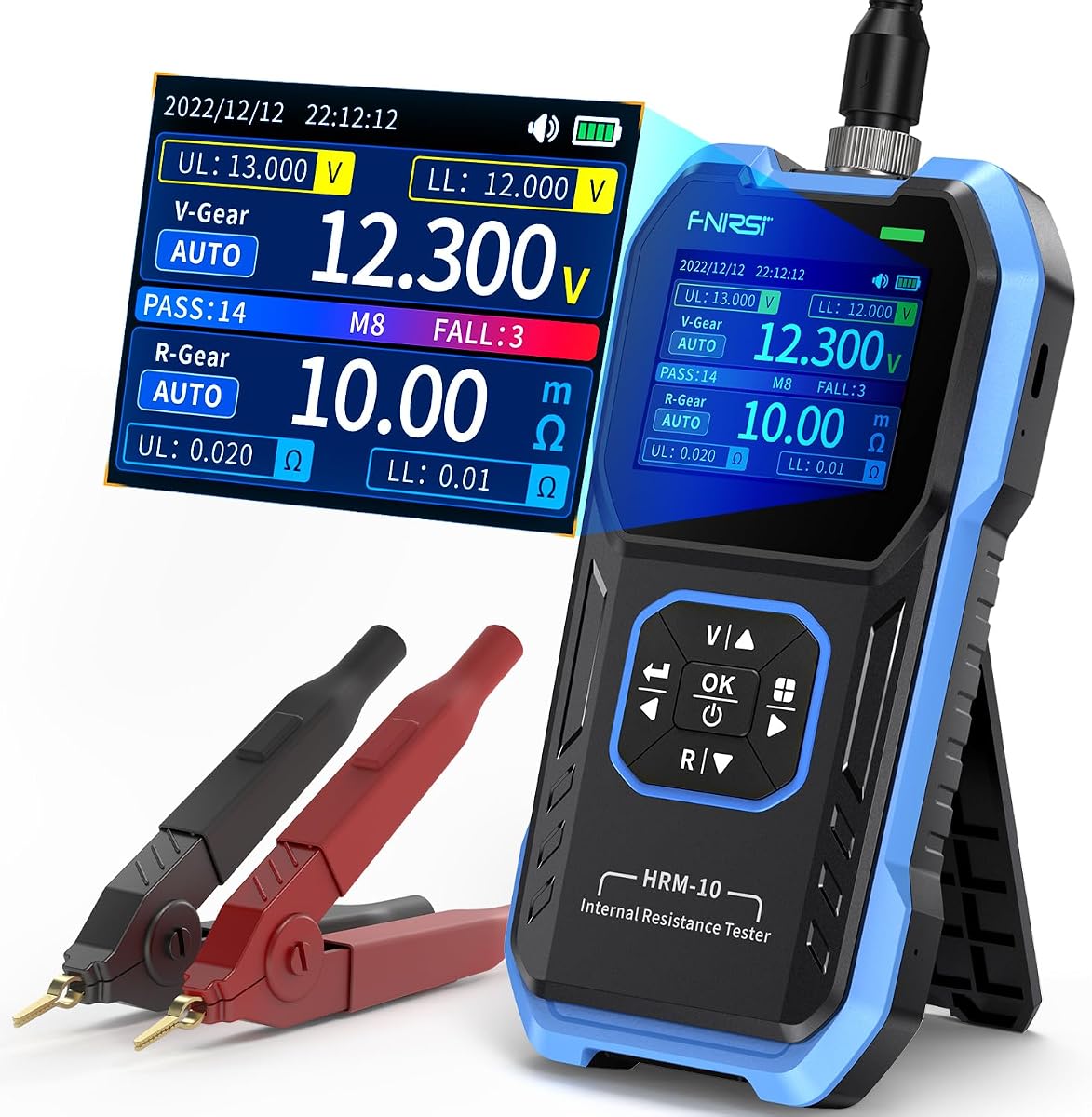
FNIRSI HRM-10 Precision Voltage Internal Resistance Battery Tester
4.4Editor score
TFT HD color display
Automatic test records
Up to 100V range
This guide compares the top battery internal resistance testers for accurate diagnostics across automotive and household applications using verified product
Choosing the right battery internal resistance tester ensures you can accurately assess battery health and performance before failure occurs. These devices measure internal resistance and voltage simultaneously to provide a clear picture of battery condition for various types.
We evaluated ten leading models based on measurement accuracy, display clarity, connectivity options, and ease of use. Our comparison focuses on features like four-wire Kelvin sensing, data logging capabilities, and compatibility with different battery chemistries and voltage ranges.
Each selection highlights specific strengths for different user needs from DIY hobbyists to professional technicians. Prices and availability change frequently so verify current details before purchasing to ensure you get the best value for your specific testing requirements.
4.4Editor score

4.5Editor score

2.2Editor score
The following table provides a side-by-side overview of all ten tested models highlighting key specifications and capabilities for informed selection.




The ZOYI ZT-XR1 stands out as a versatile tool combining a professional multimeter with a dedicated battery internal resistance tester. With a rating of 4.5 stars it delivers high-resolution measurements and comprehensive diagnostic capabilities in one unit.
We may earn a commission when you buy through this link, at no additional cost to you.
Its 25000 count True RMS multimeter functionality allows for detailed AC and DC voltage resistance and capacitance measurements. The dedicated 4-wire Kelvin sensing ensures precise battery resistance readings between 0.1mΩ and 200Ω ideal for both household and automotive applications.
Trade-offs include a higher price point compared to single-function testers and a slightly heavier build due to the integrated features. However the built-in 2000mAh battery and Type-C charging provide convenient portable power without needing external cells.
This model is best suited for technicians and serious hobbyists who need both multimeter precision and battery diagnostics. The full safety ratings and warranty support make it a reliable long-term investment for electronic repair and battery maintenance.
The 25000 count display ensures even minor voltage fluctuations are captured accurately for detailed battery health analysis.
Combining multimeter and resistance testing reduces equipment costs and storage needs for professionals working on diverse electronic tasks.
We may earn a commission when you buy through this link, at no additional cost to you.
The FNIRSI HRM-10 offers exceptional value for those seeking accurate internal resistance testing without high costs. Rated at 4.4 stars it features a vibrant TFT HD color display that makes reading results clear in various lighting conditions.
We may earn a commission when you buy through this link, at no additional cost to you.
It utilizes a customized Kelvin four-wire connection method to eliminate wire resistance errors ensuring precise measurements up to 200Ω and 100V. Users can manually adjust voltage and resistance ranges or use auto modes for convenience during batch testing.
While it lacks a rechargeable battery and caps at 100V it excels in data management with historical record storage and PC export functions. The compact design and straightforward interface make it accessible for both beginners and experienced users.
Ideal for home workshops or automotive shops needing reliable basic diagnostics this tester balances performance and affordability. Its ability to view eight sets of data simultaneously helps quickly identify failing batteries among multiple units.
The advanced color HD technology presents test results vividly enhancing user experience compared to traditional monochrome displays.
Kelvin four-wire technology avoids contact resistance issues ensuring the resistance values reflect true battery health accurately.
We may earn a commission when you buy through this link, at no additional cost to you.
The High Precision T-685 targets professional laboratory and industrial applications with its advanced measurement capabilities. Despite a lower user rating of 2.2 stars its technical specifications offer resolution down to 1 microohm and ±0.5% accuracy for both resistance and voltage.
We may earn a commission when you buy through this link, at no additional cost to you.
It supports both AC and DC resistance measurements with automatic range switching and fast testing pace of five times per second. The device features a USB port for computer connectivity and a bilingual interface supporting Chinese and English for global usability.
The main trade-off is its reliance on AC power rather than battery operation which limits field portability compared to handheld units. Additionally user feedback suggests potential reliability or usability issues that may impact overall satisfaction for casual users.
Best suited for research labs or production environments requiring extreme precision and data logging this analyzer delivers high-end performance. Its compact design and comprehensive battery compatibility make it valuable for detailed scientific or industrial battery characterization tasks.
Measuring down to 1 microohm allows detection of minute resistance changes critical for high-performance lithium battery analysis.
Support for both AC and DC resistance provides flexibility for testing various battery types and electronic components accurately.
We may earn a commission when you buy through this link, at no additional cost to you.
This versatile battery tester is designed for everyday users needing to check common household battery types efficiently. Rated 4.4 stars it supports eleven different battery formats including AA AAA C D and various lithium button cells for broad compatibility.
We may earn a commission when you buy through this link, at no additional cost to you.
The large LCD screen clearly displays voltage and battery health percentage helping you determine if rechargeables need charging or replacements. Its rotary dial interface makes selection intuitive without complex menus or buttons making testing quick and easy.
While it focuses on common batteries rather than high-voltage automotive units its portable design fits easily in toolboxes or drawers. The worry-free warranty and lifetime technical support add confidence for regular household maintenance tasks.
Perfect for parents or hobbyists managing electronics like toys or cameras this tester simplifies battery management. Its straightforward operation ensures anyone can quickly check power levels without specialized technical knowledge or equipment.
Compatibility with eleven battery types ensures you can test most common household and small device batteries with one tool.
The rotary dial and direct contact leads allow users to test batteries quickly without removing them from devices or slots.
We may earn a commission when you buy through this link, at no additional cost to you.
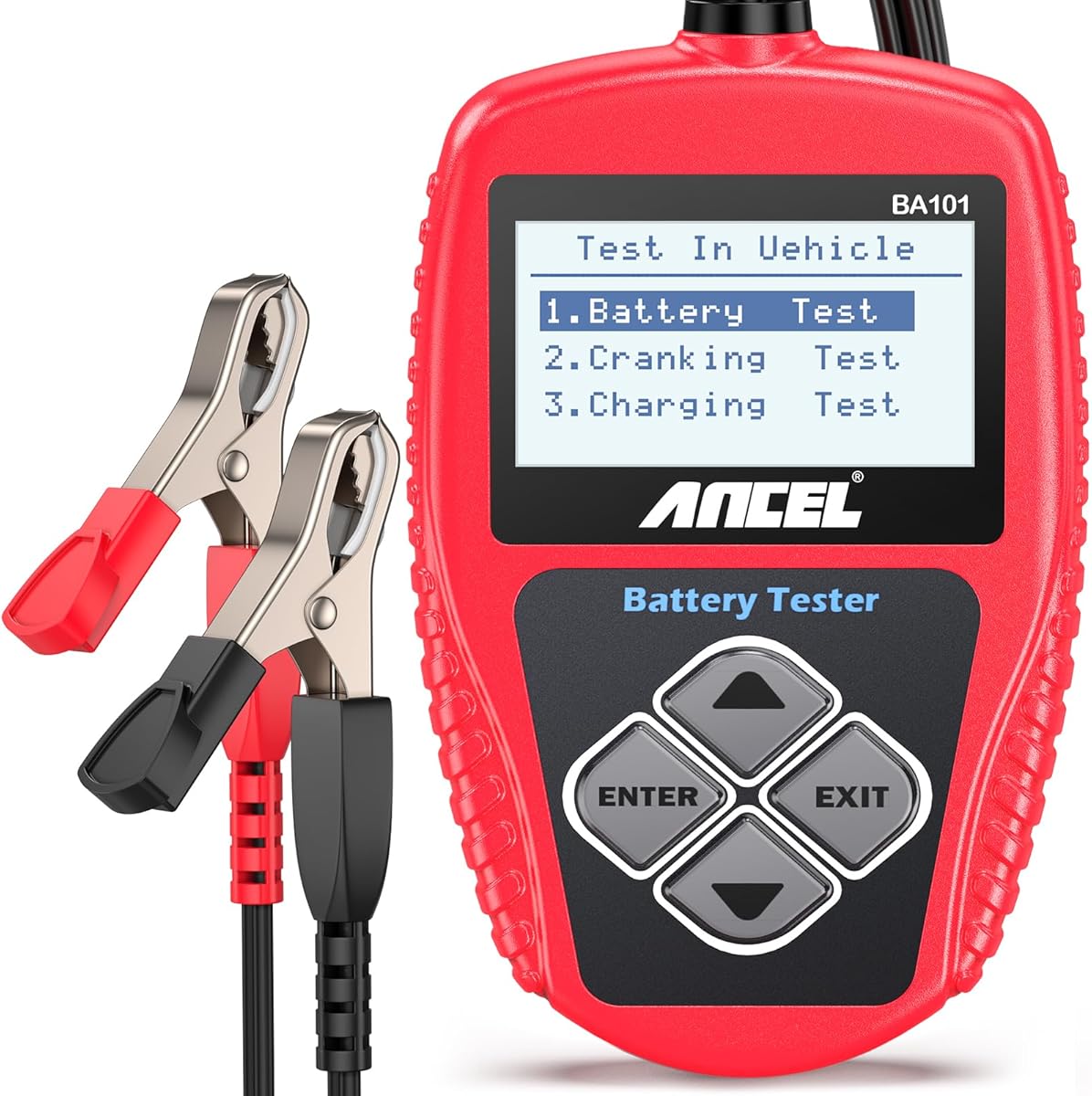
The ANCEL BA101 specializes in automotive battery diagnostics providing reliable testing for 12V systems in cars trucks and marine vehicles. With a 4.5 star rating it delivers clear State of Health and State of Charge readings to prevent unexpected breakdowns.
We may earn a commission when you buy through this link, at no additional cost to you.
Its precision smart chip and copper clips ensure dependable results when testing CCA ratings between 100 and 2000. Built-in safety features like reverse polarity and overcurrent protection guard against common testing mistakes especially in tight engine bays.
This model draws power directly from the vehicle battery eliminating the need for internal batteries or charging cycles. While it focuses on 12V lead-acid batteries it offers broad standard support for JIS EN DIN and SAE battery types.
Ideal for mechanics or vehicle owners needing straightforward automotive health checks this tester balances ease of use with professional accuracy. Its adjustable contrast screen ensures readability in bright sunlight or dim garage conditions during testing sessions.
Testing Cold Cranking Amps accurately helps determine if a battery can start engines reliably in cold weather conditions.
Built-in protection against reverse polarity and shorts prevents damage to both the tester and vehicle electrical systems.
We may earn a commission when you buy through this link, at no additional cost to you.
The ZOYI XR1 integrates a 25000-count digital multimeter with battery internal resistance testing for versatile maintenance tasks. Rated at 3.9 stars it features a TFT color display with adjustable brightness for clear viewing in different environments.
We may earn a commission when you buy through this link, at no additional cost to you.
It supports AC and DC voltage resistance capacitance and frequency measurements alongside dedicated battery testing from 0.1mΩ to 200Ω. The Type-C charging interface and configurable auto-shutdown timer enhance user convenience during extended testing sessions.
While it offers extensive technical features some users may find the setup complex compared to simpler testers. However the ability to fine-tune settings like buzzer volume and measurement ranges provides flexibility for specialized diagnostic needs.
This tool suits technicians who require both multimeter capabilities and battery health checks in one device. Its industrial design ensures durability and performance for daily use in repair shops or electronics maintenance work.
25000-count precision allows detection of small voltage changes critical for diagnosing subtle battery degradation issues.
Type-C charging supports universal power sources making recharging convenient with standard adapters found in most homes.
We may earn a commission when you buy through this link, at no additional cost to you.
The RC3563 is a lightweight handheld analyzer designed for portable battery resistance testing in field conditions. With an impressive 4.9 star rating it uses a Kalman filter algorithm to ensure high precision and stable measurement results.
We may earn a commission when you buy through this link, at no additional cost to you.
It measures both internal resistance and voltage simultaneously with four-wire Kelvin clamps to eliminate wire resistance errors. The built-in 1000mAh lithium battery charges via standard 5V USB allowing convenient use with common mobile phone chargers.
While the screen is compact it displays clear liquid crystal readings for accurate diagnostics. Its energy-saving design and lightweight construction make it ideal for scientific labs or on-site maintenance work.
Best for researchers and technicians needing portable precision this analyzer delivers reliable performance with minimal power consumption. Its broad compatibility with various battery chemistries supports diverse testing requirements without needing multiple devices.
The Kalman filter algorithm reduces noise and interference for more accurate and stable resistance readings.
Lightweight handheld design and USB charging make this tool ideal for on-the-go battery testing scenarios.
We may earn a commission when you buy through this link, at no additional cost to you.
The YR1035+ offers a straightforward and reliable solution for battery internal resistance testing with true four-wire accuracy. Rated a perfect 5.0 stars it features a large LCD screen that displays real-time voltage and resistance readings clearly.
We may earn a commission when you buy through this link, at no additional cost to you.
The complete kit includes probes and clips for easy handling during tests making it suitable for performance testing and configuration tasks. Its compact and lightweight design ensures portability for both field work and bench testing applications.
While it lacks data export features the simplicity of the interface allows for quick manual checks without complex menus. The four-wire system ensures lead resistance does not skew results providing trustworthy diagnostics for various battery types.
Ideal for hobbyists or professionals needing a no-frills accurate tester this model delivers consistent performance. Its user-friendly setup makes it accessible for anyone requiring precise battery health assessments without extra technical overhead.
Included probes and clips allow immediate testing without needing to purchase additional accessories for accurate measurements.
The true four-wire system eliminates lead resistance errors ensuring measurements reflect actual battery internal resistance.
We may earn a commission when you buy through this link, at no additional cost to you.
This New Accessories YR1035 kit provides a complete solution for testing various battery types from lithium to lead-acid. With a perfect 5.0 rating it includes a Kelvin clamp specifically designed for measuring battery terminals and lugs easily.
We may earn a commission when you buy through this link, at no additional cost to you.
The device supports Type-C charging for modern convenience and offers a measurement range from zero to 200 ohms for internal resistance. Its universal compatibility covers lead-acid lithium and button batteries making it adaptable for diverse applications.
The Kelvin clamp allows for hands-free clamping which simplifies testing by freeing your hands to handle probes safely. While the display is basic it clearly shows results for quick assessments without unnecessary complexity.
Best for users needing a comprehensive testing kit with specific hardware this set balances cost and functionality. Its simple interface and universal support make it ideal for workshops managing multiple battery technologies simultaneously.
The included Kelvin clamp enables secure clamping on battery terminals for stable and accurate resistance measurements.
Type-C charging ports ensure easy power management with widely available cables and adapters.
We may earn a commission when you buy through this link, at no additional cost to you.
The WESTOBIG Battery Tester emphasizes data management with features like automatic data presetting and PC transfer via EXCEL. Rated at 4.3 stars it supports universal batteries including automotive and household types with a measurement range of zero to 200 ohms.
We may earn a commission when you buy through this link, at no additional cost to you.
Its upgraded Kelvin four-terminal sensing ensures accurate measurements by eliminating lead resistance. The color HD display presents test results clearly while the ability to connect to a PC facilitates detailed analysis of historical data.
While the PC transfer adds analytical power it requires additional setup compared to standalone units. The auto mode and preset gear options streamline testing for users managing multiple battery batches regularly.
Best for technicians who need to archive and analyze test results this model offers strong connectivity and precision. Its comprehensive battery support and display clarity make it a practical choice for both car and household diagnostics.
Connecting to a PC allows you to transfer data to EXCEL for organized analysis and tracking over time.
Auto modes for voltage and resistance gears simplify testing by automatically selecting appropriate ranges for results.
We may earn a commission when you buy through this link, at no additional cost to you.
Selecting the right tester depends on your specific needs regarding accuracy battery types and data management capabilities.
Look for testers with Kelvin four-wire sensing to eliminate lead resistance errors which is critical for precise low-ohm readings. Higher accuracy models often specify precision percentages like ±0.5% which is vital for professional diagnostics.
Prioritize devices with proven accuracy specifications to ensure reliable battery health assessments.
Ensure the tester supports the voltage and resistance ranges of your typical batteries for automotive models check for at least 12V to 100V capability. Resistance ranges from 0.1mΩ to 200Ω cover most household and automotive needs.
Match the range capabilities to your intended battery types to avoid measurement limitations.
Clear displays such as TFT color screens improve readability in various lighting conditions compared to basic LCDs. Adjustable brightness settings help prevent eye strain during extended testing sessions.
Choose a display that provides clear and large readings for quick diagnostics.
Models with data export functions to PC via USB or EXCEL allow for long-term tracking of battery health trends. Historical record storage helps identify gradual degradation over time.
Select units with data features if you need to analyze results across multiple tests.
Battery-powered testers offer portability while those drawing power from the device under test eliminate the need for internal cells. Built-in rechargeable batteries with Type-C charging add convenience.
Consider power options based on whether you need handheld mobility or stationary testing.
Protection against reverse polarity short circuits and overvoltage prevents damage to both the tester and battery. Safety ratings like CAT II or CAT III are important for automotive applications.
Ensure safety protections are in place to guard against common electrical hazards.
Check if the tester supports the specific battery chemistries you use such as lead-acid lithium-ion or NiMH. Some models include specific accessories like Kelvin clamps for different battery terminal types.
Verify battery compatibility to ensure the device works with your specific requirements.
User-friendly interfaces with intuitive menus and auto-range settings reduce the learning curve for non-experts. Features like preset data sets help streamline repetitive testing tasks.
Choose models that match your technical comfort level for efficient operation.
Before testing ensure the battery is disconnected from any circuit or load to get accurate readings. Clean the battery terminals to remove corrosion that could interfere with the connections.
Connect the probes using Kelvin four-wire method if available ensuring the current and voltage leads are separate for precision. Select the appropriate range manually or use auto mode if supported.
After each test wipe the probes clean and store the device in a dry place away from extreme temperatures. Periodically check calibration settings or self-calibration functions to maintain accuracy over time.
Internal resistance is the opposition to current flow within a battery which increases as it ages or degrades. Higher resistance means the battery delivers less power and heats up more during use. Measuring it helps predict failure before voltage drops occur.
The four-wire Kelvin method eliminates lead and contact resistance from measurements ensuring only the battery internal resistance is measured. This accuracy is crucial for low-ohm readings typical of automotive and power batteries.
Yes most modern testers are designed to measure batteries connected to vehicles provided the system is off and safe. Always follow manufacturer safety guidelines and use reverse polarity protection to avoid short circuits.
No voltage alone can be misleading since a battery may show full voltage but have high internal resistance that limits performance. Internal resistance testing provides a more reliable indicator of actual battery health.
For automotive batteries test every six months or before winter to ensure reliable starts. For household rechargeables test before storage or when you suspect performance issues to extend their usable life.
Bad ranges vary by battery type but generally resistance values exceeding 20 percent of new battery specs indicate degradation. For example automotive batteries above 10 milliohms may need replacement depending on age and capacity.
The ZOYI ZT-XR1 FNIRSI HRM-10 and High Precision T-685 represent top choices across different use cases from integration to precision.
Prioritize four-wire Kelvin sensing and data management features if you need detailed diagnostics or long-term tracking capabilities.
Check current prices and warranty terms as these may vary to ensure you get the best value for your specific testing needs.