
NICGIGA 10Gb Base-T PCI-e Network Card
4.3Editor score
Intel X540 Controller
Supports Windows Server
Slim bracket included
This guide compares the top 10GbE network cards for PC including budget options and enterprise adapters for high-speed data transfers and gaming.
Upgrading your computer with a 10GbE network card unlocks ultra fast speeds for gaming and large file transfers. It is essential to pick an adapter that matches your motherboard and budget needs.
We evaluated ten top rated PCIe network adapters based on performance compatibility and reliability. Each product offers unique features like dual ports or specific controller chips for different use cases.
Every pick shows detailed specs pros and cons to help you decide. Prices change frequently so check current listings before buying to ensure you get the best deal available today.
4.3Editor score

4.2Editor score

4.3Editor score
This table provides a side-by-side overview of all ten network cards including their key specifications and standout features to help you compare them easily.


The TP-Link TX401 stands out as a top contender in the 10GbE network card market. It delivers speeds up to 10Gbps with low latency for smooth gaming and data transfer. Its rating reflects user satisfaction with its reliability and ease of installation.
We may earn a commission when you buy through this link, at no additional cost to you.
Key strengths include the included CAT6A cable which ensures you can achieve full speeds without buying extra accessories. The QoS technology prioritizes gaming traffic to avoid congestion. Compatibility with Windows and Linux makes it versatile for many users.
A trade-off is that it only has one port so you cannot connect multiple networks directly. Driver updates may be needed for some older Linux kernels. These issues are minor compared to the benefits of affordable high-speed performance.
Home users and gamers looking to upgrade from Gigabit to 10GbE will find this card perfect. It balances cost and performance well. We recommend it as the best overall choice for most PC builds.
The card comes with a 1.5m CAT6A cable which is rated for 10Gbps speeds. This saves money and ensures your connection is not bottlenecked by inferior cabling.
Both low-profile and full-height brackets are included. This allows you to install the card in compact mini towers or standard desktop cases without issues.
We may earn a commission when you buy through this link, at no additional cost to you.
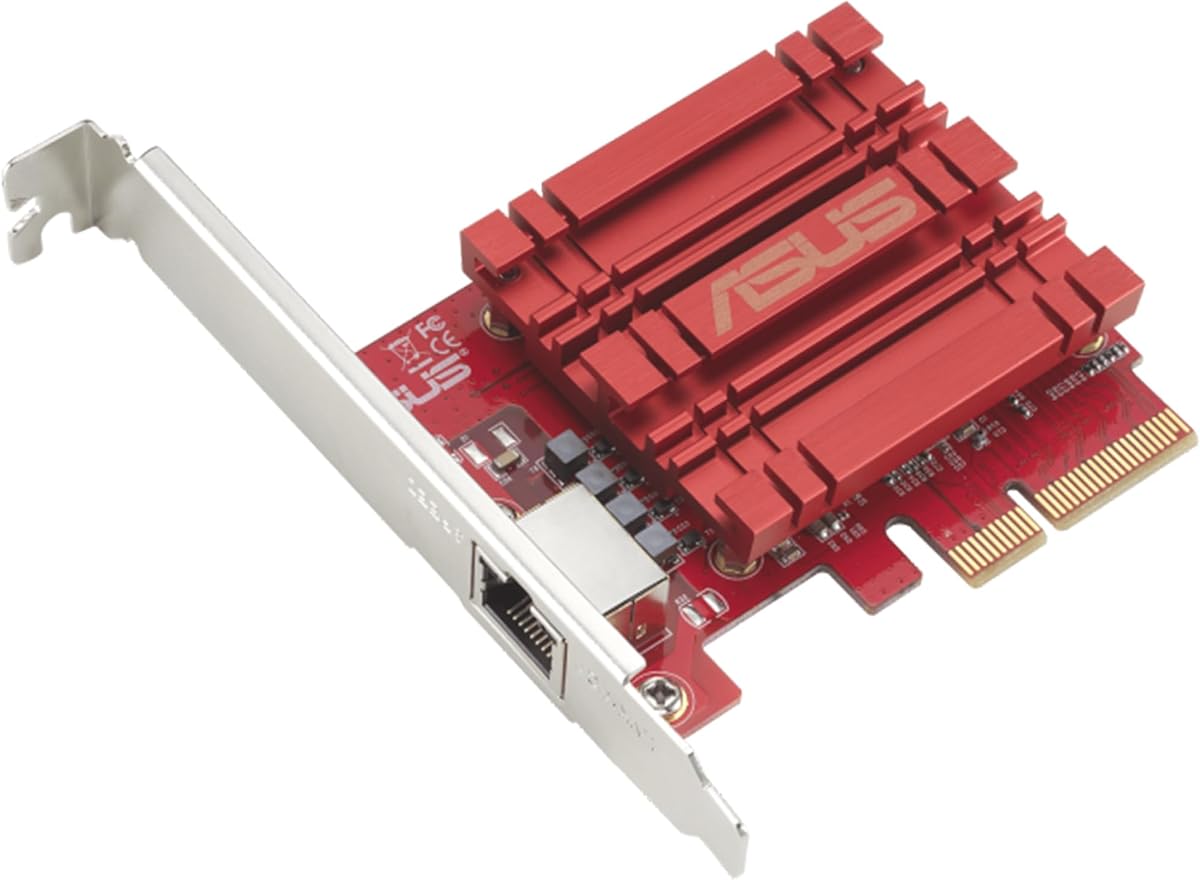
The Asus NADACA0140 provides hyper-fast 10Gbps networking suitable for bandwidth-demanding tasks. It ensures seamless backward compatibility with standard network standards. Its rating indicates solid performance for general office or home use.
We may earn a commission when you buy through this link, at no additional cost to you.
Strengths include built-in QoS which allows you to prioritize data packets for smooth online experiences. The RJ45 port lets you use standard copper cables for easy desktop upgrades. Support for Windows and Linux kernels ensures flexible OS integration.
It might be priced higher than some competitors without offering significantly more features. The card is straightforward but lacks dual ports for advanced setups. These drawbacks are acceptable if you only need a single reliable connection.
This card is a good choice for users who value brand reputation and standard features. It works well for general desktop upgrades. Consider it if you need a proven adapter without complex requirements.
The RJ45 port uses standard copper network cables for easy connection. You do not need special cabling infrastructure to get started with 10Gbps speeds.
Quality-of-Service technology helps you prioritize bandwidth for specific applications. This is useful for reducing lag during important online tasks or gaming.
We may earn a commission when you buy through this link, at no additional cost to you.
The Vogzone X550-T2 features the original Intel XL750AT2 controller which is known for server stability. It supports dual copper RJ45 ports for flexible networking. The rating highlights its reliability in demanding environments like home labs or servers.
We may earn a commission when you buy through this link, at no additional cost to you.
Key strengths include support for SR-IOV and load balancing on multiple CPUs which is great for virtualization. You can update firmware in-system without a bootable USB drive. This minimizes downtime during maintenance tasks.
You may need to manually configure negotiation speeds for 2.5G or 5G if auto-negotiation fails. This adds complexity compared to plug-and-play cards. However the benefits of dual ports and advanced features outweigh this for power users.
This card is best for server enthusiasts or those needing virtualization features. It handles high workloads well. Choose it if you require enterprise-level functionality at a reasonable cost.
The Intel XL750AT2 controller supports single-root I/O virtualization. This improves stability when running multiple virtual machines on a single physical host.
Equipped with an official NVM Update Utility for in-system firmware refresh. You can batch upgrade adapters remotely to cut manual maintenance workload.
We may earn a commission when you buy through this link, at no additional cost to you.
The VunLink network card uses the latest Realtek RTL8127 chipset for stable 10GbE performance. It features a PCIe 4.0 x1 interface which maximizes slot efficiency. The rating reflects its reliability for NAS and gaming PCs.
We may earn a commission when you buy through this link, at no additional cost to you.
It supports 10Gbps down to 100Mbps with auto-negotiation for seamless integration. The design consumes less power and produces less heat than traditional solutions. Brackets for standard and low-profile slots are included for flexibility.
You should check driver compatibility with specific Linux distributions as it may vary by kernel. Actual speeds depend on your network equipment and cabling quality. These are standard limitations for multi-gig adapters.
This adapter is ideal for Mini PCs or ITX builds due to its small footprint. It offers modern performance for home labs. Pick it if you want a power-efficient upgrade for compact systems.
The PCIe 4.0 x1 interface fits any x1 x4 x8 or x16 slot. This makes it ideal for compact Mini PCs and ITX builds without needing large slots.
Supports seamless integration with existing network equipment and speeds. It automatically negotiates between 10Gbps 5Gbps and 2.5Gbps for easy setup.
We may earn a commission when you buy through this link, at no additional cost to you.
The Intel X540T2 is a reliable adapter offering 10 Gigabit Ethernet performance for data centers. It uses standard CAT-6a cabling and RJ45 connectors. Its high rating comes from proven reliability and dual-port utility.
We may earn a commission when you buy through this link, at no additional cost to you.
Strengths include backward compatibility with existing 1000Base-T networks for easy transitions. Flexible I/O virtualization supports up to 64 virtual ports for complex setups. It unifies LAN iSCSI and FCoE in one low-cost solution.
Driver support for newer operating systems may be less seamless than newer cards. Being an older model it might lack features like auto-negotiation for 2.5G speeds. These are acceptable trade-offs for its proven stability and low cost.
Enterprise users or those needing two independent 10G connections will find this valuable. It is a cost-effective way to add dual ports. Consider it for robust server or networking builds.
As an industry first dual-port 10Gbase-T adapter it offers two independent connections. This allows for redundancy or separate network segments on one card.
It delivers LAN iSCSI and FCoE in one low-cost Converged Network Adapter. This simplifies your storage and network infrastructure without extra hardware.
We may earn a commission when you buy through this link, at no additional cost to you.
The TRENDnet TEG-10GECTX offers reliable 10G networking with specific compliance features. It supports speeds up to 10Gbps via a PCIe Gen 3.0 x4 interface. The rating highlights its dependability for business users.
We may earn a commission when you buy through this link, at no additional cost to you.
A major strength is NDAA and TAA compliance which is required for government customers in the US and Canada. It includes 3 years of manufacturer protection and English-speaking tech support. The 2.5G Base-T support works with Cat5e cables.
The compliance is only relevant for specific regions which may not matter for everyone. The design is straightforward with no extra frills like virtualization support. These factors make it best for those needing compliant hardware.
Choose this card if you need a certified adapter for government or enterprise contracts. It offers peace of mind with warranty and support. It is a safe choice for professional installations.
NDAA and TAA compliant Network Adapters meet government demands. You can plan installations that satisfy specific regulatory standards in the US and Canada.
The adapter is backed by 3 years of TRENDnet Manufacturer Protection. Their team of advisors and tech experts are available for your needs.
We may earn a commission when you buy through this link, at no additional cost to you.
The YuanLey card delivers ultra-fast 10Gbps performance powered by the Realtek RTL8127AT chipset. It features a PCIe 4.0 x1 interface with backward compatibility for older slots. The rating is strong due to user-friendly features and support.
We may earn a commission when you buy through this link, at no additional cost to you.
Key strengths include hardware checksum offload which reduces CPU usage. It supports Wake-on-LAN functionality for remote wake-up of your computer. The package includes standard and low-profile brackets for flexible installation.
Driver installation may require some manual steps on certain Linux versions. The card relies on standard cabling so your network must support 10Gbps to see full benefits. These are minor considerations for a value-oriented card.
This card is excellent for home labs and NAS users needing remote management. The lifetime support adds significant value. Select it for a balance of performance and long-term assistance.
Wake-on-LAN allows you to power on your computer remotely. This helps manage devices easily without walking to the physical system to turn it on.
The product comes with lifetime support for setup guidance. Expert teams provide responsive service to ensure a smooth networking experience from day one.
We may earn a commission when you buy through this link, at no additional cost to you.
The TP-Link TX201 delivers speeds up to 2.5 Gbps which is faster than typical Gigabit adapters. It includes QoS technology for prioritized gaming performance. Its rating is excellent indicating high user satisfaction.
We may earn a commission when you buy through this link, at no additional cost to you.
It supports multiple data rates automatically negotiating between 2.5 Gbps and lower speeds. The card includes both low-profile and full-height brackets for flexible installation. It also supports Wake on LAN for remote power management.
It is limited to 2.5Gbps speeds so it is not a full 10GbE solution. Single port means no redundancy or secondary network connections. These limitations are acceptable given the low price point.
Best for users wanting a fast upgrade without the cost of full 10GbE. It works well for home or light office use. Pick it if 2.5Gbps meets your bandwidth needs.
With 2.5G Base-T Technology the TX201 delivers speeds 2.5x faster than Gigabit. It is a cost-effective way to upgrade home networks significantly.
Wake on LAN lets you remotely power on or off your computer. This helps manage devices more easily without physical access to the machine.
We may earn a commission when you buy through this link, at no additional cost to you.
The WAVLINK adapter offers speeds up to 10 times faster than traditional gigabit rates. It is compatible with Windows 11 10 and Linux operating systems. The rating reflects its solid performance for everyday tasks.
We may earn a commission when you buy through this link, at no additional cost to you.
It features robust metal shielding which minimizes electromagnetic interference. The card works with PCI Express slots configurations like x4 x8 and x16. Low-profile and standard brackets ensure flexible installation in different setups.
Users should download drivers from the official site to avoid security flags. The card lacks advanced virtualization features found in enterprise models. These are acceptable trade-offs for a general-purpose adapter.
This card is a good mid-range choice for home and office upgrades. It supports common OS versions well. Consider it if you need reliable 10G connectivity without complex features.
Robust metal shielding minimizes electromagnetic interference. This enhances stability and reliability for your 10g network interface card with every connection.
The PCIe ethernet card accommodates various PCI Express slot configurations. It works with x1 x4 x8 and x16 slots for easy installation.
We may earn a commission when you buy through this link, at no additional cost to you.
The NICGIGA adapter adopts the Intel X540 Controller for up to 10 Gbps speed. It supports Windows Server Linux VMware and ESX operating systems. The rating indicates it is a stable solution for local data transmission.
We may earn a commission when you buy through this link, at no additional cost to you.
It converts PCIe slots into 10G RJ-45 Ethernet ports efficiently. The adapter comes with standard and slim brackets for different applications. Its heat dissipation design helps maintain stability during transmission.
It requires PCIe X8 or X16 slots which may limit compatibility with smaller systems. The X540 controller is older and may not support newer protocols. However its cost and VMware support make it a practical choice.
This card is best for users running VMware ESX environments who need affordable 10G access. It provides reliable performance. Choose it for server workloads where cost is a priority.
The adapter supports Windows Windows Server Linux VMware and ESX. This makes it suitable for virtualization environments and server upgrades.
Excellent heat dissipation performance quickly reduces temperature. This keeps the stability of network transmission during heavy workloads.
We may earn a commission when you buy through this link, at no additional cost to you.
Choosing the right network card requires understanding your system slots bandwidth needs and compatibility requirements.
Check your motherboard to see if it has an available PCIe slot. Most 10GbE cards require at least x1 x4 or x8 lanes. Ensure the slot matches the card's interface to avoid bandwidth issues.
Verify your motherboard supports the required PCIe generation and lane count for optimal performance.
Ensure the network card supports your specific OS version. Most cards support Windows 10 and 11 but Linux support may vary by kernel version. Always check the manufacturer documentation for compatibility lists before purchasing.
Confirm that drivers are available for your OS to guarantee seamless installation and functionality.
Decide if you need a single port or dual ports. Dual ports allow for link aggregation or failover setups which are useful for servers. Single ports are simpler and cheaper for standard desktop use.
Select single port for desktops and dual ports for servers needing redundancy or bandwidth pooling.
Different cards use different chipsets like Intel Realtek or Marvell. Intel controllers are often preferred for server environments due to stability. Realtek chips offer good value for home and consumer use.
Choose Intel for servers and Realtek for cost-effective consumer upgrades.
Look for cards that include low-profile and full-height brackets. This ensures the card fits in both standard towers and compact mini-towers. Check your PC case specifications before buying to avoid fit issues.
Ensure brackets match your PC case size to guarantee proper installation.
If you run virtual machines look for SR-IOV support. This allows the card to be shared among VMs efficiently. Features like QoS help prioritize traffic which is crucial for gaming or VoIP.
Look for SR-IOV and QoS if you use VMs or need traffic prioritization.
To get full 10Gbps speeds you need proper Ethernet cables. Cat6A is recommended for 100m distances at 10Gbps. Older cables may limit speed so plan your infrastructure upgrades accordingly.
Use Cat6A cables to ensure full 10Gbps speeds over standard distances.
Check the warranty length and support options. Most cards come with 2 or 3 years of protection. Access to technical support can save time if you face installation or driver issues.
Prioritize products with solid warranty periods and reliable technical support channels.
First install the card in your PCIe slot carefully aligning the contacts. Use the included brackets to secure it to the case back panel.
Next connect a Cat6A cable to the port and ensure it clicks into place. Install any necessary drivers from the official manufacturer website.
Finally verify connection speed in your network settings to confirm 10Gbps operation. Monitor temperatures and keep vents clear for optimal stability.
To achieve full 10Gbps speeds you should use Cat6A Ethernet cables. Older Cat5e cables may work but only at shorter distances or lower speeds. Using proper cables ensures stable performance.
Most modern PCs support 10GbE cards via PCIe slots. Check your motherboard manual for available slots like x1 x4 or x8. Ensure your OS has driver support for the specific card model.
You can connect to older routers but speeds will be limited to the router capacity. The card supports backward compatibility so it works with Gigabit ports at lower speeds. You need a 10G switch for full benefits.
Installation is similar to adding a graphics card. You insert the card into a PCIe slot and secure it with a bracket. Install drivers afterward to enable the network connection properly.
Single port cards have one network connection while dual port cards have two. Dual ports allow for link aggregation to increase bandwidth or failover. Single ports are cheaper and sufficient for most users.
Most 10GbE cards support Linux but driver compatibility varies. Some require kernel updates or manual driver installation. Always check the manufacturer's supported Linux versions before buying.
Yes they reduce latency and improve download speeds. QoS features can prioritize game traffic for better performance. However you need a matching 10G network setup to see benefits.
10GbE cards are durable and often last for many years. Proper cooling and clean environments extend their lifespan. Manufacturer warranties usually cover 2 to 3 years of use.
We reviewed ten top 10GbE network cards offering options for every need. The TP-Link TX401 leads as the best overall choice with great value.
For advanced users consider the Vogzone X550-T2 for dual ports and virtualization. Budget buyers might prefer the NICGIGA adapter for server use.
Always check your system compatibility and current listings before purchasing. Prices change frequently so verify details to secure the best deal today.