
DHT11 Temperature Humidity Sensor Module
4.3Editor score
Single wire digital output
Wide voltage range support
Affordable entry level option
Compare the top Arduino temperature sensor models for accuracy, range, and ease of use in your next electronics project or home automation setup today.
Choosing the right Arduino temperature sensor is crucial for accurate data logging and environmental monitoring. Whether you need humidity tracking or waterproof probes, selecting a reliable module ensures your projects run smoothly without calibration headaches.
We evaluated ten leading sensors based on accuracy, voltage range, communication protocol, and build quality. Each option was reviewed for compatibility with popular boards like Arduino Uno and ESP32 to help you find the perfect fit for your needs.
Each pick highlights key specs and ideal use cases so you can decide quickly. Remember that stock and pricing may vary over time, so check the latest listings before ordering your components for your next build.
4.3Editor score

5.0Editor score

4.9Editor score
This side-by-side comparison highlights the key specifications and strengths of each sensor to help you match the right hardware to your specific application requirements.




The HiLetgo DHT11 module is a classic choice for beginners needing basic temperature and humidity data. It features a single-wire digital output that simplifies connections to your microcontroller board. With a pre-calibrated sensor and onboard components, it reduces the need for external circuitry.
We may earn a commission when you buy through this link, at no additional cost to you.
Its narrow measuring range covers common indoor environments making it perfect for weather stations or home monitoring. The module includes a bypass capacitor and pull-up resistor on board which streamlines assembly. Communication is straightforward requiring minimal code to read values.
While accuracy is adequate for hobby projects it may not suffice for industrial applications requiring tight tolerances. The temperature range stops at fifty degrees Celsius which limits outdoor use in extreme heat. Still its reliability and price point make it a strong entry option.
Buy this if you need multiple affordable sensors for simple educational or indoor projects. It pairs well with Arduino Uno or Nano boards for quick prototyping. For higher precision or wider ranges consider upgrading to the DHT22 or AHT30 later.
The single-wire protocol reduces pin usage and coding complexity for fast setup.
Ideal for tracking room conditions where extreme temperature fluctuations are unlikely.
We may earn a commission when you buy through this link, at no additional cost to you.
The AHT30 module delivers outstanding accuracy with a temperature tolerance of plus or minus 0.3 Celsius. Its I2C interface supports multiple devices on the same bus allowing scalable sensor networks. Voltage flexibility between 2.0 and 5.5V makes it compatible with various boards.
We may earn a commission when you buy through this link, at no additional cost to you.
Stable transmission speeds and low power draw make it suitable for battery-powered or portable projects. The four-pin test line connection simplifies wiring for users new to digital sensors. It supports simultaneous online access to multiple I2C electronic devices efficiently.
Unlike single-wire options you will need two data pins plus power and ground which uses more microcontroller resources. Ensure proper pull-up resistors are in place for stable communication. Despite this extra wiring the precision gains are often worth the effort.
Choose this sensor for projects demanding high accuracy like climate control or lab equipment. It outperforms basic DHT models in stability and resolution. For complex builds where data integrity matters this module provides a robust foundation.
The I2C protocol allows connecting multiple sensors without consuming many GPIO pins.
Low current consumption extends battery life in portable or wireless sensor nodes.
We may earn a commission when you buy through this link, at no additional cost to you.
The SHT31 module from Teyleten Robot offers an expansive temperature range spanning from minus 40 to 125 Celsius. This makes it ideal for industrial monitoring or outdoor weather stations exposed to extreme conditions. It maintains a tight accuracy of plus or minus 0.3 Celsius throughout.
We may earn a commission when you buy through this link, at no additional cost to you.
Its I2C interface ensures reliable data transfer while the wide operating voltage accommodates different power supplies. The pack includes three units which is convenient for multi-node projects. Humidity accuracy stands at two percent RH across the full measurement range.
While slightly more expensive than entry options the performance justifies the cost for demanding applications. The wide voltage range simplifies integration with systems using higher supply voltages. Ensure you have an I2C library ready for Arduino development.
Select this for projects requiring robustness against temperature extremes or high precision. It is a strong contender for professional prototypes or long-term environmental logging. The included quantity adds value for testing across multiple locations.
The wide temperature range supports usage in freezing or very hot environments safely.
Receiving three units in one package reduces per-unit cost for larger deployments.
We may earn a commission when you buy through this link, at no additional cost to you.
The Gikfun DS18B20 sensor is designed for wet or harsh environments with a waterproof probe and long one-meter cable. An adapter module with pull-up resistor simplifies connection to microcontrollers. This kit includes three sets for multi-point monitoring needs.
We may earn a commission when you buy through this link, at no additional cost to you.
Its measuring range extends from minus 55 to 125 Celsius which covers most thermal monitoring tasks. The pluggable probe allows easy deployment in tanks greenhouses or machinery. Wires are color coded for straightforward identification during assembly.
Note that while the probe is waterproof the lead wires may not withstand extreme heat near the connection point. You might need to add an external resistor if the board lacks one. Still it offers great value for industrial or aquarium use.
Buy this for aquariums HVAC systems or industrial equipment where moisture is present. The adapter module removes wiring guesswork for beginners. If you need durability in damp conditions this sensor is a trusted choice.
The included adapter module allows direct connection to most microcontrollers quickly.
Waterproof construction protects the sensor in submerged or humid applications safely.
We may earn a commission when you buy through this link, at no additional cost to you.
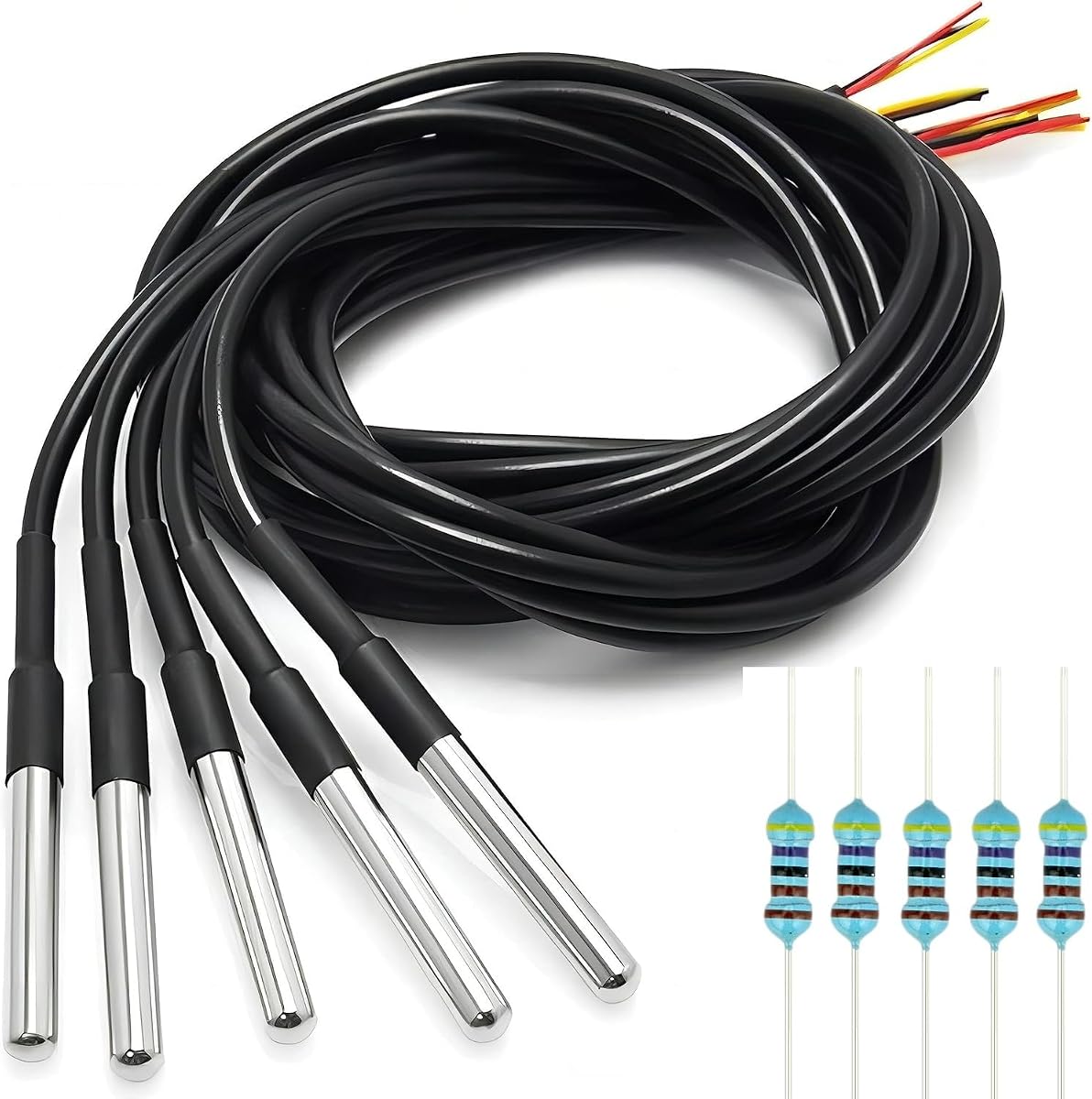
This pack provides five DS18B20 probes plus matching resistors making it a comprehensive solution for multiple projects. The sensors are waterproof and rated for wide temperature ranges from minus 55 to 125 Celsius. Wiring follows standard color codes for easy integration.
We may earn a commission when you buy through this link, at no additional cost to you.
High accuracy of plus or minus 0.5 Celsius ensures reliable readings across the range. Compatibility extends to Arduino Raspberry Pi and ESP32 boards which broadens your project options. The included resistors save time when setting up the one-wire protocol.
Without adapter boards you will solder or connect wires directly to your microcontroller pins. This might require basic electronics knowledge but offers flexibility in placement. If you prefer pre-wired modules this could be a slight downside.
Choose this for large scale projects needing many sensors like distributed temperature monitoring. The inclusion of resistors simplifies setup for DIY enthusiasts. It is an excellent option for budget-conscious buyers needing quantity.
Receiving resistors with the sensors removes a common step in wiring setups.
Works with multiple microcontroller families allowing you to swap boards easily.
We may earn a commission when you buy through this link, at no additional cost to you.
The two-pack DHT11 module offers an affordable entry into digital sensing with reliable long-term stability. It features a single-wire scheme that reduces programming effort and pin usage on your board. Output is digital eliminating the need for analog-to-digital conversion.
We may earn a commission when you buy through this link, at no additional cost to you.
Humidity and temperature ranges suit typical indoor environments which is great for home automation. The module uses a dedicated microcontroller inside to ensure consistent readings. Wires are included so you can connect immediately without extra components.
Accuracy is acceptable for general monitoring but not for critical scientific measurements. If you need wider ranges or better precision consider stepping up to DHT22. However for basic projects this package delivers solid value per unit.
Buy this for student labs or hobby kits where cost is a primary concern. It works well with Arduino Raspberry Pi and similar boards. Having two units allows testing different locations or redundancy.
Low per-unit cost makes it ideal for classrooms or bulk prototype testing.
Included wires and simple protocol reduce setup time significantly for beginners.
We may earn a commission when you buy through this link, at no additional cost to you.
The DROK DS18B20 probe features a corrosion-resistant stainless steel body ideal for continuous submersion or harsh conditions. Each set includes adapter boards jumper wires and resistors for a fully equipped setup. Accuracy remains tight at plus or minus 0.5 Celsius across the range.
We may earn a commission when you buy through this link, at no additional cost to you.
The adapter board integrates a pull-up resistor enabling direct connection to GPIO pins without extra components. Heat shrink tubing on wires provides additional strain relief and durability. Operating voltage is flexible accommodating 3.0 to 5.5V systems.
Compared to bare probes this kit offers convenience and robustness for demanding environments. The two-pack count is lower but the quality of each unit is superior. It is designed for users needing reliability over quantity.
Select this for industrial monitoring aquariums or weather stations requiring durability. The stainless steel construction ensures longevity in wet or corrosive settings. If you value build quality this kit stands out as a premium solution.
Stainless steel casing resists rust and corrosion in long-term outdoor or underwater use.
Included adapters and wires eliminate extra purchases to streamline initial setup.
We may earn a commission when you buy through this link, at no additional cost to you.
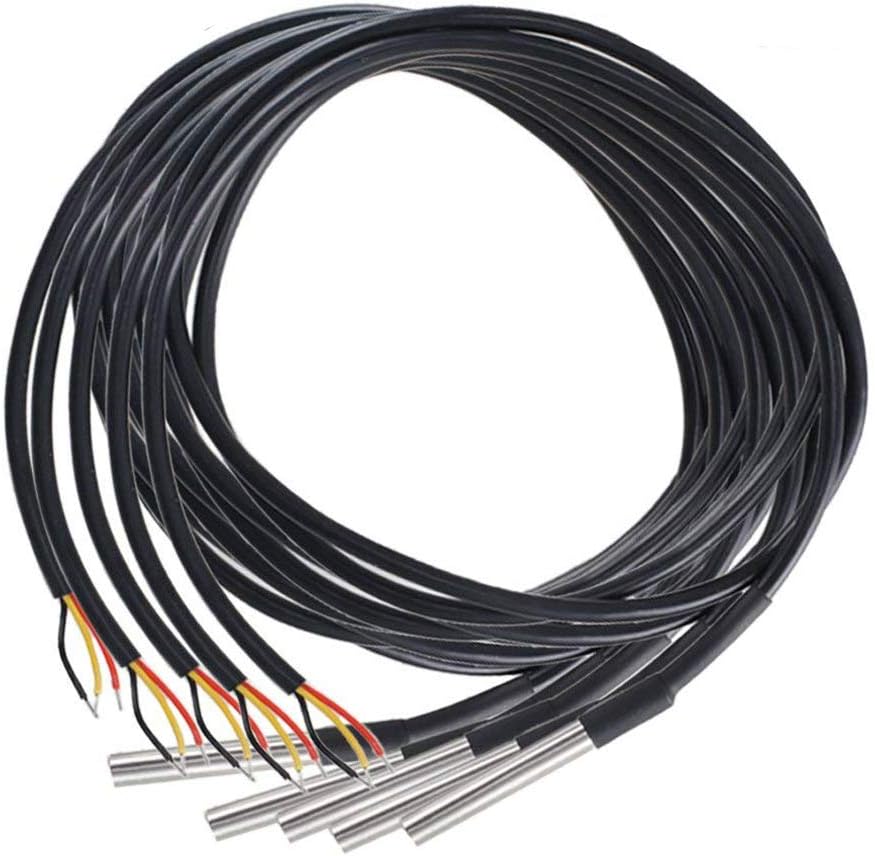
This five-pack provides long one-meter cables for flexible sensor placement across large areas. The waterproof digital probes operate reliably between minus 55 and 125 Celsius for diverse thermal needs. Each unit uses a single bus interface minimizing microcontroller resource usage.
We may earn a commission when you buy through this link, at no additional cost to you.
The absence of adapter boards keeps costs low but requires careful wiring. A 4.7K resistor is recommended between data and VCC for stable readings. This setup is perfect for distributed sensing like greenhouse monitoring or pipe tracking.
Without built-in resistors you must ensure your wiring includes the pull-up element. This adds a tiny bit of complexity but offers customization in cable routing. The length allows reaching distant points from your main controller.
Buy this for projects needing multiple long-distance sensors at a reasonable price. It is a popular choice for home automation where sensors are spread out. For bulk deployments this kit balances performance and convenience.
One-meter cables allow placing sensors far from the main microcontroller board.
Five units in one package reduces the cost per sensor for large projects.
We may earn a commission when you buy through this link, at no additional cost to you.
The DHT22 improves on the DHT11 with better accuracy and a wider operating range from minus 40 to 80 Celsius. It uses the AM2302 chip for high sensitivity across the full humidity span of zero to one hundred percent RH. Single-bus output simplifies wiring.
We may earn a commission when you buy through this link, at no additional cost to you.
Temperature measurement accuracy reaches plus or minus 0.5 Celsius which is superior to entry models. The bidirectional serial data allows more efficient communication with microcontrollers. A fixing screw hole makes it easy to mount in enclosures securely.
Timing requirements are slightly stricter than DHT11 so ensure your code handles delays properly. Still it offers a clear upgrade for projects needing better precision without the cost of industrial sensors. It replaces older models like SHT11 effectively.
Choose this for climate control or weather stations where accuracy matters. It fits well into DIY electronic practice kits needing reliable data. For better performance than basic sensors this is a solid mid-range pick.
Better temperature accuracy improves data reliability for scientific or control projects.
Integrated screw holes provide stable mounting in enclosures or custom fixtures.
We may earn a commission when you buy through this link, at no additional cost to you.
This bundle includes five stainless steel waterproof probes rated for wide temperature ranges and long cable runs. Each sensor uses a digital thermal probe design ensuring stable readings even in moisture. The stainless steel casing resists corrosion for longevity.
We may earn a commission when you buy through this link, at no additional cost to you.
Power supply operates between 3.0 and 5.5V making it compatible with most microcontrollers. Wiring is color-coded for quick identification during assembly. For stable testing use a 4.7K resistor between data and power lines.
While adapters are not included the stainless steel build quality is robust for industrial or outdoor use. You will need to manage resistors externally but the bundle quantity offsets this minor drawback. It serves well for multi-point monitoring.
Buy this for large water tanks greenhouse rows or factory floors needing multiple sensors. The stainless steel build ensures reliability in harsh conditions. It balances price and quality for bulk waterproof applications.
Stainless steel packaging protects internal components from rust and moisture damage.
Five units allow monitoring several zones simultaneously without extra purchasing.
We may earn a commission when you buy through this link, at no additional cost to you.
Selecting the right sensor depends on your project requirements including accuracy range and environmental conditions. This guide covers key factors to consider before purchasing.
Check the minimum and maximum operating temperatures your project will face. Sensors like DS18B20 cover -55 to 125C while DHT models are limited to 0-50C or similar indoor ranges.
Ensure the sensor supports your intended environment to avoid failure or inaccurate readings in extreme conditions.
For general monitoring DHT11 or DHT22 provides acceptable accuracy. If you need tighter tolerances choose SHT31 or AHT30 models offering 0.3C precision.
Higher accuracy sensors often cost more but are necessary for scientific or industrial applications.
Single-wire sensors like DS18B20 save GPIO pins but require precise timing. I2C sensors like SHT31 or AHT30 allow multiple devices on two pins.
Pick a protocol that matches your microcontroller's available pins and library support.
If the sensor will be submerged or in a humid area choose a waterproof probe with stainless steel housing. Models like DS18B20 are rated for such conditions.
Standard modules without waterproofing should stay dry to prevent short circuits.
Most sensors work on 3.3V or 5V but check the exact range. Some support wide voltages like 2.0 to 5.5V for flexible power supply options.
Ensure your board matches the sensor voltage to avoid damage.
Buying packs of multiple units can reduce costs. Check if adapters or resistors are included to save time.
Consider how many sensors you need for distributed monitoring or testing.
Some modules include screw holes or boards for mounting while others are bare probes. Think about how you will secure the sensor in your enclosure.
Adapter boards simplify wiring but might add size.
Battery-powered projects benefit from low-power sensors like AHT30. High-performance sensors might draw more current.
Check data sheets for active vs sleep mode current if running on batteries.
Connect the sensor to your microcontroller using the recommended wiring. Ensure VCC GND and DATA lines are secure and match color codes.
Install the appropriate library for your sensor model like Adafruit_DHT or DallasTemperature. Upload a basic sketch to verify readings appear in the Serial Monitor.
Keep the sensor dry unless it is waterproof. Protect it from dust and direct sunlight when measuring ambient temperatures for accurate results.
The AHT30 and SHT31 offer the highest accuracy with tolerances of 0.3C. These are ideal for professional or scientific projects where precision is critical.
Yes, the DS18B20 waterproof probe is designed for submersion. Ensure the cable connections remain dry to avoid electrical issues.
Some models like DS18B20 require a 4.7K pull-up resistor. Kits often include these. Modules with onboard resistors save you this step.
DHT22 or AHT30 work well for indoor weather stations due to humidity tracking. For outdoor use SHT31 offers wider temperature ranges.
You can connect multiple DS18B20 sensors to a single data pin using the one-wire protocol. Each needs a unique address handled by the library.
Inconsistent readings may result from loose wiring power issues or missing pull-up resistors. Verify your circuit and add decoupling capacitors if needed.
Yes, waterproof probes like DS18B20 can measure both air and water temperatures. Just ensure the sensor casing is compatible with the medium.
Common libraries include Adafruit_DHT for DHT sensors and DallasTemperature for DS18B20. The SHT31 uses the Adafruit_SHT31 library.
We reviewed ten top options ranging from budget DHT11 modules to precise SHT31 units. Each has strengths depending on your need for accuracy range or waterproofing.
Prioritize accuracy and durability if your project demands reliable data. For beginners cost and simplicity often outweigh high precision.
Check current pricing and availability as offers may change. Pick the sensor that aligns with your project goals and budget.