
Estes 1427 Alpha III
4.4Editor score
Iconic classic design
High altitude potential
Affordable entry point
This guide compares the top DIY Model Rocket Kits for beginners and intermediates, evaluating flight height, assembly time, safety features, and included
Choosing the right DIY Model Rocket Kit can spark a lifelong passion for aerospace and engineering in young minds. These kits provide hands-on STEM learning experiences that teach physics, aerodynamics, and safety protocols through exciting launches.
We compared ten leading models based on assembly complexity, flight performance, safety compliance, and value. Our analysis focused on how well each kit teaches building skills while ensuring reliable launches for first-time rocketeers.
Each pick highlights unique features like pre-built options or advanced engineering challenges. Remember that prices fluctuate frequently, so check current listings before purchasing to ensure you get the best deal available today.
4.4Editor score

4.5Editor score

4.7Editor score
This side-by-side comparison evaluates all ten selected kits across key metrics including altitude, assembly time, skill level, and included accessories to help you find the perfect match.



The Estes 1469 Tandem X stands out as the premier DIY Model Rocket Kit for beginners seeking comprehensive value. With a solid 4.5 rating, it offers two distinct rocket models in one box, maximizing the fun and learning opportunities available to young enthusiasts.
We may earn a commission when you buy through this link, at no additional cost to you.
This kit includes the Amazon and Crossfire ISX models, which differ in design and altitude capabilities. The Amazon reaches 600 feet while the Crossfire ISX hits 1,150 feet, providing variety in flight experiences. The inclusion of a Porta Pad II Launch Pad and Electron Beam Launch Controller ensures you are ready to launch immediately upon assembly.
While batteries and engines are sold separately, this is standard for most high-quality kits to allow customization. The assembly process takes about one hour per rocket, making it a perfect weekend project. Safety features align with NAR codes, ensuring responsible flying practices are taught from the start.
For families or educators looking for a complete package that offers variety without complexity, the Tandem X is the top choice. It balances ease of use with educational depth, making it an ideal starting point for any budding rocketeer.
Getting two rockets in one kit doubles the engagement time and allows comparing different aerodynamic designs side by side.
Having the pad and controller included removes the need for additional purchases before your first successful launch event.
We may earn a commission when you buy through this link, at no additional cost to you.
The Estes 1427 Alpha III is a legendary choice for those seeking an affordable entry into the world of model rocketry. With a 4.4 rating, it proves that budget-friendly does not mean compromising on performance or educational value for beginner rocketeers.
We may earn a commission when you buy through this link, at no additional cost to you.
This kit focuses on simplicity and reliability. The Alpha III model is known for its stable flight characteristics and ability to reach altitudes of 1,150 feet. It comes with the essential Porta-Pad II Launch Pad and Electron Beam Launch Controller, ensuring you have everything needed for a safe launch.
While it only includes one rocket, the assembly process is straightforward and takes about one hour. The included decals add a touch of personalization without requiring paint or advanced tools. This makes it perfect for young children who want quick results without frustration.
If you need a cost-effective solution that still delivers a complete launch experience, the Alpha III is unmatched. It is an excellent first kit that often leads to a deeper interest in building more complex models later.
At a lower price point than many competitors, it offers all critical components including the launch system for under thirty dollars.
As an iconic model, parts are readily available, and online tutorials make troubleshooting easy for new builders.
We may earn a commission when you buy through this link, at no additional cost to you.
The Estes 2452 Athena is designed for those who want to skip the building phase and head straight to the launch pad. With a 4.5 rating, it is perfect for younger children or gift-givers seeking immediate gratification without assembly hassle.
We may earn a commission when you buy through this link, at no additional cost to you.
This kit arrives fully assembled, saving significant time and effort. It features a bright 12-inch parachute for safe recovery and flies up to 1,125 feet with a C6-7 engine. The only preparation needed is a 15-minute setup before takeoff.
While you miss out on the construction aspect of typical DIY kits, this is a strong choice for testing interest in the hobby. It removes barriers like glue drying time or paint supplies, making it ideal for school events or party activities.
If your goal is to focus on the science of flight rather than the craftsmanship, the Athena is the right tool. It ensures a successful first launch experience that can inspire further exploration into building kits later.
You can take this rocket to a field within minutes of unboxing, making it perfect for urgent or impromptu activities.
Prebuilt quality control ensures all parts are secure, reducing the risk of mid-flight failure due to assembly errors.
We may earn a commission when you buy through this link, at no additional cost to you.
The Estes 1441 Journey brings a unique outer-space theme to the DIY Model Rocket Kit category. With a 4.5 rating, it captures the imagination of children interested in space exploration while providing a robust build and launch experience.
We may earn a commission when you buy through this link, at no additional cost to you.
This kit includes the Journey rocket model, which reaches up to 1,100 feet. It comes with the Porta-Pad II Launch Pad and Electron Beam Launch Controller to ensure a smooth operation. The assembly takes roughly one hour and includes decals to enhance the space aesthetic.
The educational value lies in the thematic elements that encourage research into space and aerospace engineering. Parents can use the rocket to discuss planets, orbits, and the history of space travel while building the model together.
For families looking to combine play with educational storytelling, the Journey is an excellent selection. It offers the right balance of building challenge and thematic excitement to keep kids engaged throughout the process.
The space design encourages discussions about real-world space missions and the physics behind escaping Earth's gravity.
With the pad and controller included, you avoid the need to research additional compatibility or purchasing separate systems.
We may earn a commission when you buy through this link, at no additional cost to you.
The Estes 0689 Celestial Explorer offers a sleek aesthetic that distinguishes it from standard cylindrical rockets. With a 4.1 rating, it appeals to those who appreciate design elegance alongside functional performance in their DIY Model Rocket Kit.
We may earn a commission when you buy through this link, at no additional cost to you.
This model features a precision-cut fin system designed for stability during flight. It can reach altitudes of 1,000 feet using a C6-5 engine. The assembly is quick, taking under an hour, making it accessible for those with limited patience for detailed work.
While it does not include a launch pad or controller, the core build quality is solid. The elongated body provides a different aerodynamic profile that is great for learning about how shape affects flight stability compared to traditional models.
If you want a rocket that looks distinct and flies reliably without complex assembly, the Celestial Explorer is a strong contender. It is a practical choice for hobbyists who already have launch systems and just need a new airframe.
The unique body shape teaches about drag reduction and streamlined flight paths in an intuitive visual way.
Simplified construction steps reduce the chance of frustration for younger children or those new to building models.
We may earn a commission when you buy through this link, at no additional cost to you.
The Estes 1499 Rascal and Hijinks set is a powerhouse for immediate fun. With a 4.5 rating, it delivers two prebuilt rockets and a launch system in one package, making it a fantastic choice for parties or group events.
We may earn a commission when you buy through this link, at no additional cost to you.
Both rockets can reach altitudes of 1,100 feet, ensuring high performance despite the lack of assembly. The included Porta Pad II Launch Pad and Electron Beam Launch Controller mean you have a complete launch ecosystem right out of the box.
Because these models are fully assembled, there is zero build time. This eliminates potential errors in construction that could lead to launch failures. It is ideal for users who prioritize flying over building and want reliable results every time.
For those seeking a turnkey solution for backyard fun, this duo set is hard to beat. It combines the thrill of flight with the convenience of pre-assembly, ensuring that everyone can participate in the launching process immediately.
Having two rockets allows for races or staggered launches, keeping a group entertained throughout a single session.
The inclusion of the launch pad saves money and ensures you have compatible hardware for your first flight.
We may earn a commission when you buy through this link, at no additional cost to you.
The Estes 1948 Big Bertha is tailored for intermediate builders ready to tackle more complex materials. With a 4.6 rating, it offers a rewarding project that bridges the gap between beginner kits and advanced engineering challenges.
We may earn a commission when you buy through this link, at no additional cost to you.
This model features laser-cut balsa fins and a durable body tube, providing a more professional build experience. It flies to 500 feet with a slow, realistic liftoff that mimics full-scale rockets. The assembly takes about an hour and requires careful attention to detail.
While the altitude is lower than many beginner rockets, the flight dynamics are more realistic. This makes it perfect for learning about stability and aerodynamics without the extreme speed of smaller, faster rockets. It is a great step up for experienced hobbyists.
If you want to challenge your skills with wood and detailed assembly, the Big Bertha is the ideal choice. It teaches patience and precision while delivering a fun and scientifically interesting flight experience.
Working with balsa wood introduces woodworking skills and teaches proper alignment for stable flight characteristics.
This kit offers a middle ground that keeps experienced builders engaged without becoming overly complicated or expensive.
We may earn a commission when you buy through this link, at no additional cost to you.
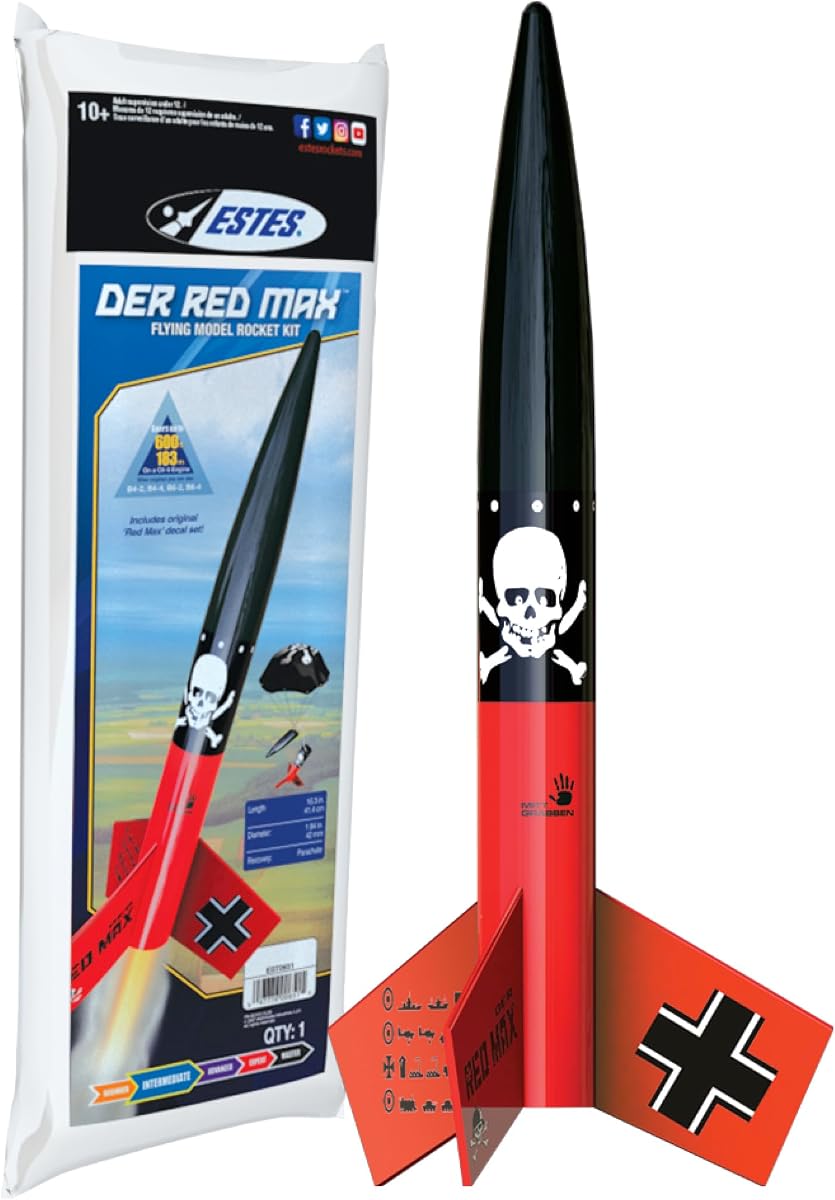
The Estes 0651 Der Red Max is a classic intermediate model that balances design and performance. With a 4.6 rating, it is perfect for hobbyists who appreciate retro aesthetics and solid engineering in their DIY Model Rocket Kit.
We may earn a commission when you buy through this link, at no additional cost to you.
This rocket features a large, stable design with laser-cut wood fins for improved performance. It reaches 600 feet and takes about two hours to assemble. The build process is a rewarding project that encourages focus and technical skill development.
While it takes longer than beginner kits, the result is a highly stable airframe. The design is iconic and serves as a great example of traditional rocket engineering. It is suitable for those ready to spend time on a quality build.
For builders looking to advance their skills with wood construction and classic styling, the Der Red Max is a top pick. It offers a satisfying middle ground between simple plastic kits and complex professional models.
This kit provides a tangible lesson in how fin size and shape contribute to overall rocket stability and control.
The classic look is visually appealing and can spark conversations about the history of model rocketry design.
We may earn a commission when you buy through this link, at no additional cost to you.
The Estes 3238 Pathfinder offers great value by including two flight models and a launch system. With a 4.3 rating, it is designed to help aspiring rocketeers build, launch, and recover their models with minimal hassle.
We may earn a commission when you buy through this link, at no additional cost to you.
Each rocket can reach 1,000 feet, providing ample flight time for practice. The kit includes the Porta-Pad II Launch Pad and Electron Beam Launch Controller, ensuring a complete setup. Assembly is quick, taking under an hour per rocket.
This set is perfect for those who want variety without managing multiple separate purchases. The consistent altitude performance means you can compare builds side by side without worrying about major flight differences due to hardware variances.
If you want a cost-effective way to learn the full cycle of rocketry from build to recovery, the Pathfinder is a smart choice. It provides all the necessary tools to get started with a comprehensive and flexible kit.
Including the launch controller and pad in a two-rocket set ensures you have everything needed for repeated sessions.
The parachutes included are effective for recovery, teaching the importance of safe return in every mission.
We may earn a commission when you buy through this link, at no additional cost to you.
The Estes 1295 Mean Machine is the pinnacle of advanced DIY Model Rocket Kits for those seeking a serious engineering challenge. With a 4.7 rating, it stands as the most robust and rewarding build available for hobbyists ready to commit time and skill.
We may earn a commission when you buy through this link, at no additional cost to you.
This model is 80 inches tall, making it the largest option in this comparison. It reaches 700 feet using an E12-6 engine and features a twist-lock connector for professional assembly. The build time is 3+ hours, requiring patience and advanced building skills.
The premium price and complexity reflect the detailed engineering involved. It includes a 24-inch parachute for safe recovery. This kit is designed for those who want to push their limits and learn about structural integrity in flight.
For advanced hobbyists looking for a project that demands time and precision, the Mean Machine is the ultimate choice. It delivers a sense of accomplishment that smaller kits cannot match for experienced rocketeers.
The large size and twist-lock connectors teach about structural design and how to secure large airframes safely.
Using E12 engines provides significant power, requiring careful calculation of flight parameters and safety zones.
We may earn a commission when you buy through this link, at no additional cost to you.
Selecting the right DIY Model Rocket Kit involves evaluating skill level, budget, and desired flight experience to ensure a safe and rewarding hobby journey.
Beginner kits typically take one hour or less to assemble and use pre-colored plastic parts or simple decals. Intermediate models often require wood fins, glue, and more precision, taking up to two hours. Advanced kits may demand three hours or more and involve twist-lock connectors or specialized tools.
Choose a kit that matches the builder's patience and skill. If you want instant results, look for prebuilt options. If you want to learn construction, select a build-required kit.
Many kits include a launch pad and controller, which is convenient for first-time buyers. Others require you to purchase these separately. Verify if the kit comes with the Porta Pad II and Electron Beam Controller to avoid extra costs.
If you plan to buy multiple rockets over time, you may already have a launch system. For your first purchase, an all-in-one kit saves money and ensures compatibility.
Altitude ranges vary from 500 feet for slow realistic liftoffs to 1,150 feet for high-flying fun. Higher altitudes require stronger engines and more careful safety zones. Consider how much sky space you have available for launches.
Higher altitude rockets are exciting but require a larger open field. Beginner friendly altitudes around 1,000 feet are safe for most parks and backyards.
Ensure the kit adheres to NAR safety codes, including safety keys and launch controllers. All rockets should have parachutes for recovery. Avoid models without proper recovery systems to prevent damage or injury.
Safety should always be the priority. Look for kits that explicitly state compliance with national safety standards and include clear instructions for safe launch procedures.
Some kits offer two rockets in one box, doubling the fun and providing variety. Others focus on a single, high-quality model. More models mean more practice opportunities without additional purchases.
If you plan to share the hobby with friends or siblings, a dual-rocket kit is more cost-effective. Single models are better if you want to focus on building one perfect aircraft.
Remember that engines, starters, recovery wadding, and batteries are often sold separately. These recurring costs should be factored into your budget. Some kits include more accessories than others.
Calculate the total cost including these consumables. A slightly more expensive kit that includes more initial accessories might be cheaper in the long run.
Materials range from plastic to balsa wood to durable body tubes. Plastic is easy for kids, while wood teaches woodworking skills. Durable materials improve flight stability and reusability.
Wood fins offer better aerodynamics but require more care. Plastic parts are resilient for younger builders but may look less premium over time.
Parachute size and recovery methods impact how easily you can retrieve the rocket after launch. Larger parachutes like 12 to 24 inches ensure slower descents. Proper recovery prevents damage to the rocket body.
Choose models with adequate parachute sizes for their altitude. A rocket that lands softly will last longer and provide more repeated launch sessions.
Before the first launch, assemble the rocket carefully following all instructions. Ensure all fins are aligned and glue is fully dry. Check for any loose parts that could detach during flight.
Select a safe launch site at least 15 feet away from trees or buildings. Insert the safety key and ensure the launch controller is connected properly. Use the countdown procedure to alert everyone nearby before ignition.
After landing, retrieve the rocket gently to avoid damage. Check for loose parts or worn parachutes before storing. Keep engines and batteries in a cool dry place to maintain safety and performance.
Most kits do not include engines or batteries. These are sold separately to allow customization and reuse. You will need to purchase C or B engines and AA batteries for most launch systems.
Advanced kits like the Mean Machine are designed for experienced builders. They require longer assembly times and stronger engines. Beginners should start with beginner kits to learn safety and basic assembly skills.
Most beginner kits reach between 1,000 and 1,150 feet. Intermediate models often fly lower for stability, while advanced ones can hit various heights depending on the engine used.
With proper care, you can reuse rockets many times. The airframe is durable, but parachutes and connectors may wear out over time. Engines are single-use and must be replaced after each launch.
Most kits recommend ages 10 and up due to assembly requirements and launch safety. Younger children should always be supervised by an adult when building or launching any model rocket.
Open fields or parks far from buildings are ideal. Ensure you have a clear path for recovery. Always follow local regulations and safety codes regarding open burning or ignition.
The 10 best DIY Model Rocket Kits reviewed offer options for every skill level from quick prebuilt fun to complex engineering challenges. The Tandem X stands out as the top pick for its included launch system and dual rocket variety.
Prioritize safety and compatibility when making your choice. Ensure your launch site and local regulations support your chosen altitude range. Matching the kit to the builder's patience and skill will ensure a positive first experience.
Remember that prices change frequently and accessories like batteries are often sold separately. Check current listings for the best deals before purchasing. With the right kit, you can ignite imaginations and explore the science of flight.