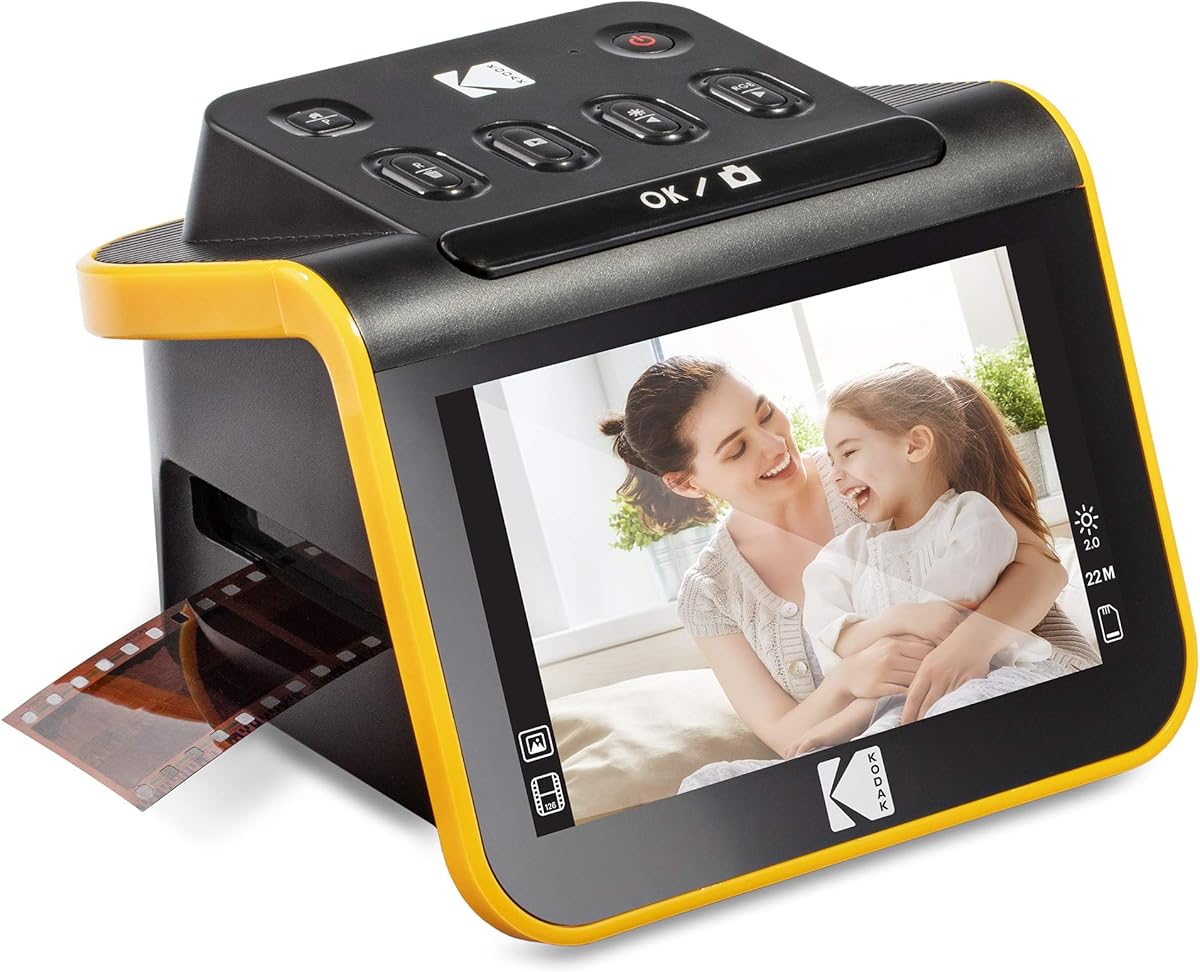
KODAK Slide N Scan Film & Slide Scanner
4.3Editor score
22MP resolution capture
Built-in LCD preview
Multiple film adapters
Digitizing your physical photos requires a reliable flatbed scanner designed specifically for film and slides. These devices capture fine details while preserving color accuracy across various formats.
We evaluated ten leading models based on resolution, software features, and ease of use. Our analysis focuses on how each scanner handles negatives, slides, and medium format media efficiently.
Each pick highlights key strengths and ideal use cases for different needs. Prices and availability change frequently, so verify current details before purchasing your preferred model.
4.3Editor score

4.4Editor score

4.5Editor score
As an Amazon Associate we earn from qualifying purchases.
This side-by-side comparison outlines the core capabilities of each scanner model. It highlights resolution, connectivity, and specific film handling features to simplify your selection process.


The Epson Perfection V850 Pro stands out as a top-tier choice for serious archivists. Its high optical resolution ensures sharp captures of even the smallest grain details in negatives.
We may earn a commission when you buy through this link, at no additional cost to you.
Users benefit from the dual lens system which optimizes clarity for both small slides and larger prints. The built-in Digital ICE technology significantly reduces manual editing time by removing dust automatically.
While the cost is higher than entry-level models, the professional-grade output justifies the investment. It handles medium format film effectively without requiring external adapters.
This scanner is ideal for professionals who need archival-quality digital copies. It delivers reliable results for both personal collections and commercial restoration projects.
The dual lens system selects the optimal lens for the media type, ensuring maximum sharpness across all formats.
Built-in hardware and software streamline the digitization process, reducing the need for post-processing edits.
We may earn a commission when you buy through this link, at no additional cost to you.
This compact scanner offers an accessible entry point for families looking to digitize memories. It supports a wide range of film types without needing a computer connection.
We may earn a commission when you buy through this link, at no additional cost to you.
The large LCD screen allows for immediate previewing and editing, making it user-friendly for non-technical users. Its simple interface reduces the learning curve significantly.
Though it lacks the ultra-high resolution of professional units, it provides good quality for online sharing and basic prints. The included adapters handle 135 and 110 film formats easily.
It is perfect for casual users who prioritize ease of use over professional-grade output. This model makes preserving old photos quick and straightforward.
The built-in screen and simple controls allow you to scan and save directly to an SD card instantly.
Adapters for various film sizes ensure you can digitize almost any slide or negative you own.
We may earn a commission when you buy through this link, at no additional cost to you.
The Epson Perfection 4870 PRO is a robust workhorse designed for professional workflows. It offers exceptional color depth that preserves subtle tonal variations in old prints.
We may earn a commission when you buy through this link, at no additional cost to you.
Users receive a professional software bundle that enhances its already strong hardware capabilities. This combination ensures high fidelity scans suitable for detailed restoration tasks.
While Firewire connectivity may require adapters on newer computers, the stability it offers is unmatched for large batch jobs. The high optical resolution captures fine textures effectively.
This model is best for professionals who need consistent, high-volume scanning performance. It remains a reliable tool for serious digital archiving projects.
With 48-bit color depth, this scanner captures nuances that standard devices might lose during digitization.
Built to withstand heavy use, this scanner maintains performance over years of intensive digitization work.
We may earn a commission when you buy through this link, at no additional cost to you.
This scanner is designed for those who value sharpness and tonal range. The dual lens system provides flexibility for different media sizes and resolutions.
We may earn a commission when you buy through this link, at no additional cost to you.
Users appreciate the 16-bit grayscale depth which helps in restoring old black and white photos. The high resolution ensures that details are not lost during enlargement.
The lack of automatic dust removal means more manual cleaning may be required. However, the image quality produced often outweighs this inconvenience for detail-oriented users.
It is a strong contender for photographers who need high fidelity prints. It delivers professional results suitable for fine art reproduction.
The 6400 dpi resolution allows for massive enlargements without visible pixelation or loss of detail.
Advanced bit depth options help preserve subtle shadow details that are often lost in older scans.
We may earn a commission when you buy through this link, at no additional cost to you.
This model balances performance with cost for home office environments. It handles both documents and film with ease due to its transparency unit.
We may earn a commission when you buy through this link, at no additional cost to you.
Digital ICE technology removes scratches quickly, saving time during processing. The LED technology ensures fast warm-up and low energy consumption during operation.
Users may find the software interface slightly dated compared to newer options. Despite this, the hardware performance remains reliable for regular digitization tasks.
It is ideal for users who need a multi-purpose scanner. It handles standard documents while still providing good quality for personal photo archives.
ReadyScan LED technology means no warm-up time, allowing you to start scanning immediately.
The transparency unit supports various film formats, making it a great hybrid for mixed media.
We may earn a commission when you buy through this link, at no additional cost to you.
The V600 is a dependable choice for photo enthusiasts needing high resolution. It captures fine details in prints and negatives effectively for digital storage.
We may earn a commission when you buy through this link, at no additional cost to you.
The included software package provides essential tools for enhancement and restoration. This allows users to improve image quality without needing external applications.
Scan times can be longer due to the high resolution settings. However, the quality of the final file makes the wait worthwhile for important archives.
This scanner is suitable for hobbyists focusing on personal photo collections. It offers a solid balance of features without excessive complexity.
Included software features allow for easy fixing of faded images and dust removal.
Customizable buttons let you set one-touch scanning for common tasks quickly.
We may earn a commission when you buy through this link, at no additional cost to you.
Designed for high-end photographers, this scanner excels with medium format film. The dual lens system ensures sharpness regardless of the film size used.
We may earn a commission when you buy through this link, at no additional cost to you.
Its high dynamic range captures details in shadows that other scanners miss. This is crucial for preserving the nuance of original prints and negatives.
The price is a significant factor for most home users. However, for professionals requiring archival quality, the output justifies the investment cost.
It is perfect for studios needing to digitize large negatives efficiently. It delivers consistent results for demanding archival projects.
The system automatically chooses the right lens for the scan area to maximize optical sharpness.
A 4.0 Dmax rating ensures deep shadows retain detail during the scanning process.
We may earn a commission when you buy through this link, at no additional cost to you.
This model is built for large originals that do not fit standard scanners. It accommodates A3 size documents and transparency strips effectively.
We may earn a commission when you buy through this link, at no additional cost to you.
The Color II imaging system enhances vibrancy during the scan process. It is particularly effective for restoring faded color prints quickly.
While the resolution is lower than dedicated film scanners, it works well for general documents. It is a strong choice for mixed media offices.
Ideal for designers needing to scan large artwork or proofs. It provides a wide surface area for handling oversized materials.
The bed accommodates large originals, removing the need for multi-pass scanning.
Easy photo fix technology restores colors automatically with minimal user input required.
We may earn a commission when you buy through this link, at no additional cost to you.
This version emphasizes energy efficiency while maintaining high resolution. It captures sharp images suitable for detailed archival purposes.
We may earn a commission when you buy through this link, at no additional cost to you.
The 48-bit color depth ensures smooth transitions in colors. This helps in creating realistic digital copies of original photographs.
Users might notice slower speeds compared to newer models. However, the energy savings make it a cost-effective option for long-term use.
It fits well in eco-conscious environments needing reliable scanning. It offers a solid middle ground for resolution and efficiency.
Energy Star compliance ensures low power consumption during operation.
High bit depth captures subtle color nuances for lifelike reproductions.
We may earn a commission when you buy through this link, at no additional cost to you.
This scanner is tailored for wide-format needs with solid connectivity. It handles large documents and art with high color fidelity.
We may earn a commission when you buy through this link, at no additional cost to you.
Firewire support offers fast data transfer rates for large files. The high bit depth ensures rich color output for professional graphics.
It is an older model which may require specific drivers. However, its wide bed remains useful for large scanning tasks.
Best suited for studios needing wide-format capability. It provides a reliable solution for oversized documents.
Accommodates A3 sized originals allowing for large document scanning.
USB and Firewire connections ensure compatibility with various computer setups.
We may earn a commission when you buy through this link, at no additional cost to you.
Choosing the right scanner involves understanding your specific needs regarding resolution, media size, and budget.
Optical resolution determines the level of detail your scanner can capture. For film and slides, a minimum of 3200 dpi is recommended to preserve grain and texture effectively.
Higher resolutions like 6400 dpi are ideal for enlargements. Always check the optical rating rather than interpolated values to ensure accuracy.
Ensure the scanner supports your specific film types. Look for built-in transparency units that handle 35mm, medium format, and various slide formats.
Adapters are crucial for 110 or 126 films. Verify that the scanner comes with all necessary trays before purchasing.
Good software simplifies the digitization process. Look for tools like Digital ICE for automatic dust removal and color correction features.
Some scanners offer direct saving to SD cards which helps users who prefer not to use a computer. This feature speeds up the workflow significantly.
Bit depth affects color accuracy and contrast. A 48-bit color depth captures more tonal information than standard 24-bit scanners.
This is particularly important for restoring faded images. More data means better results during the editing process.
Modern scanners usually use USB 3.0 for fast data transfer. Older models might use Firewire which requires specific ports on your computer.
Check your computer ports before buying. Adapters can solve compatibility issues but add to the overall cost.
A sturdy build ensures longevity. Look for units with robust lids and stable bases to avoid vibration during scanning.
Quality materials help maintain the optical alignment over time. This is critical for consistent results over years of use.
Prices range from affordable home units to expensive professional models. Determine your priorities between resolution and cost.
Entry-level models are fine for sharing photos online. Professional tools are needed for large prints or restoration work.
Old film often has dust and scratches. Hardware-based dust removal saves hours of manual editing.
Look for technology like ICE that scans the image twice to clean it. This feature is worth the extra cost for collectors.
Always handle film and slides by the edges to prevent fingerprints. Use a soft brush to remove dust before placing them in the holder.
Keep the scanner bed clean by wiping it gently with a lint-free cloth. Avoid harsh chemicals that could damage the glass surface.
Store your scanner in a dry environment to prevent internal damage. Cover it when not in use to avoid dust accumulation on the lid.
For high-quality archiving, a resolution of at least 4000 dpi is ideal. This captures fine details that might be lost at lower settings. Ensure the scanner supports this optically for the best results.
Most modern scanners come with software designed to invert negatives. However, using dedicated third-party software can give more control over color correction.
Use compressed air or a soft brush to remove loose dust. Wipe gently with a microfiber cloth if necessary. Never use water or alcohol on the film surface.
Optical resolution is the physical limit of the scanner. Interpolated resolution is software-enhanced and does not add real detail. Always prioritize optical specs.
Standard flatbeds handle 35mm well. For medium format, ensure the model supports it. Some units have specific trays for larger negatives.
Most require a computer connection. However, some standalone models save directly to SD cards. Check the connectivity options before buying.
It depends on the resolution. High-resolution scans can take several minutes. Lower settings are faster but sacrifice detail.
Yes, many flatbeds include a transparency unit for film. This allows you to scan photos and negatives in one device.
We reviewed ten models ranging from affordable home units to professional-grade equipment. Each offers unique features for different needs.
Prioritize optical resolution and dust removal features when comparing options. These determine the quality of your final digital files.
Verify current pricing and availability before purchasing. Models may vary in stock depending on the region.