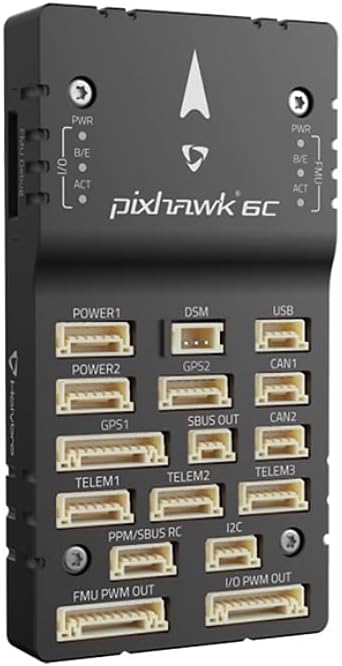
Pixhawk 6C Flight Controller
4.8Editor score
High performance H7 processor
Dual redundant IMUs
Vibration isolation system
This guide compares ten top flight controllers for Hybrid Vtol and Vtol Drones focusing on performance, firmware support, and build quality for diverse drone
Flight controllers serve as the brain of any drone, managing stability, navigation, and flight modes. For hybrid VTOL and VTOL designs, the controller must handle both fixed-wing and multirotor dynamics seamlessly. Choosing the right unit ensures smooth transitions and reliable autonomous capabilities for your build.
We evaluated ten leading flight controllers based on processor power, sensor redundancy, firmware compatibility, and physical design. Our comparison highlights units that support ArduPilot, PX4, and INAV, ensuring flexibility for hobbyists and professionals. Each entry includes detailed specifications to help you match hardware to your specific airframe needs.
Every pick in this list showcases unique strengths ranging from budget-friendly options to high-end redundant systems. You will find insights on sensor suites, expansion ports, and ESC integration where available. Please note that availability and pricing may vary by region and time, so verify details before purchasing your next component.
4.8Editor score

4.8Editor score

5.0Editor score
This comparison table provides a side-by-side look at the key specifications of all ten flight controllers reviewed in this guide to help you identify the most suitable controller for your hybrid or VTOL drone project.


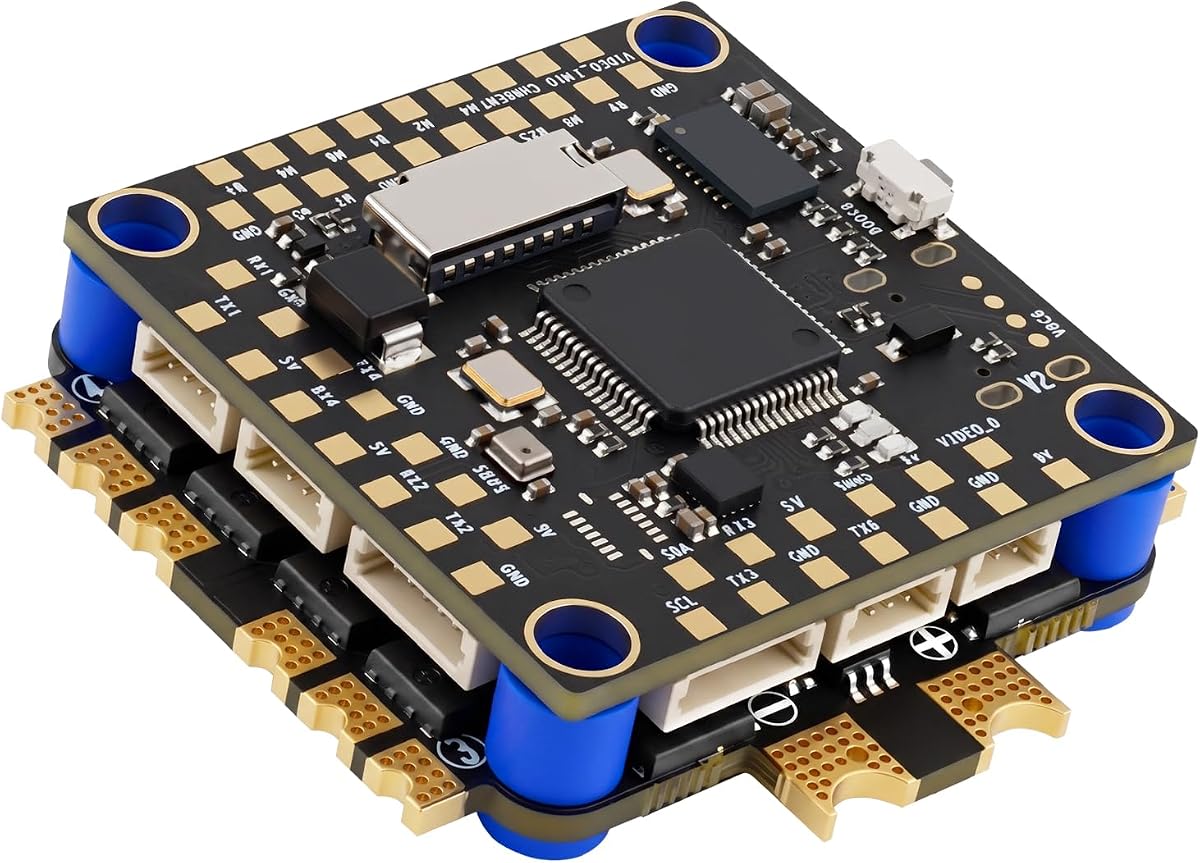

The Pixhawk 2.4.8 PX4 Open Source Flight Controller stands out as a robust solution for complex hybrid VTOL builds. With its high rating of 4.8 stars, it appeals to developers who need an open source platform capable of handling fixed wing and multirotor dynamics alike. Its standalone nature ensures that you have full control over flight logic without proprietary lock in. This controller provides a foundation for autonomous driving systems and standard drone tasks requiring precise navigation. Its flexibility makes it a top choice for those who want to experiment with flight parameters extensively.
We may earn a commission when you buy through this link, at no additional cost to you.
Its key strengths lie in its high end processor and comprehensive module support. The advanced 32F427 ARM Cortex M4 Core provides the computational power needed for real time decision making. The built in fail-safe co-processor adds a critical layer of safety for autonomous missions or VTOL transitions. The inclusion of the MPU 6000 3-axis accelerometer ensures stable attitude estimation even in turbulent conditions. This combination of processing and sensing allows for smooth transitions between hover and forward flight modes essential for hybrid aircraft.
Trade-offs exist primarily in its physical design and age compared to newer silicon. While the performance is excellent, the layout may require careful wiring to avoid signal noise. Some users might find the need for manual configuration slightly steep for absolute beginners compared to plug and play stacks. However these are acceptable given the depth of functionality provided. The quality inspection and warranty support offer peace of mind for those investing in this system for long term use.
You should buy this controller if you prioritize open source freedom and multi vehicle support. It is ideal for researchers and enthusiasts who wish to carry out secondary development projects. The ready guide makes basic assembly manageable for DIY drone projects. For anyone building a sophisticated VTOL system that requires reliable autopilot capabilities, this unit remains a highly recommended platform.
The open source nature allows developers to modify code for specific mission needs without restrictions.
You can use one controller for fixed wing, multirotor, or even surface vehicles with simple configuration changes.
We may earn a commission when you buy through this link, at no additional cost to you.
The COREWING F405 V2 Flight Controller is positioned as a versatile unit suitable for both RC airplanes and drones. Its name suggests a focus on traditional fixed wing performance while maintaining the flexibility to handle multirotor configurations. This dual purpose nature is valuable for hybrid VTOL builds that need to switch between distinct flight modes efficiently. The F405 processor ensures that you get modern processing speeds for complex control loops.
We may earn a commission when you buy through this link, at no additional cost to you.
Its strengths are in its general purpose design that fits standard RC setups. The board is built to handle the diverse inputs required for both planes and multirotors. Its simplicity can be an advantage for builders who want a straightforward control solution without excessive configuration steps. The integration into RC airplane and drone systems is direct, reducing the need for complex adapter setups.
However, details on its specific sensor suite are not as transparent as other models. You may need to verify the onboard gyroscope and accelerometer quality before committing to large scale builds. This lack of public specification can be a hurdle for those requiring precise flight data logging. Yet for general hobby flying where high precision is less critical, it remains a functional option.
This controller is a good choice for hobbyists upgrading from older platforms. It offers a cost effective path to F405 processing power for RC airplane projects. If you are building a standard VTOL with basic transition needs this unit should meet your requirements without unnecessary complexity.
The controller is tailored to handle the specific aerodynamic demands of fixed wing flight patterns.
It supports both RC airplane and drone modes allowing for a unified hardware solution for mixed fleets.
We may earn a commission when you buy through this link, at no additional cost to you.
The PIX 2-12S Flight Controller is explicitly designed for VTOL Multirotor applications. It combines a strong STM32F405VGT6 main controller with essential sensors like the MPU6500 gyroscope and LPS22HB barometer. This combination ensures accurate altitude and orientation control which is vital for hybrid flight transitions. The board supports a wide voltage range from 2 to 12S making it adaptable to various power systems.
We may earn a commission when you buy through this link, at no additional cost to you.
Its strengths include the comprehensive connectivity options and receiver support. The GH1.25 connector allows for easy integration of GPS SBUS PPM and CRSF receivers. This flexibility ensures that you can choose your preferred receiver system without worrying about port limitations. The barometer addition supports precise altitude holding during both hover and forward flight phases essential for VTOL stability.
You should note that the unit does not include an ESC which may increase build complexity. The basic wiring and absorbers may require careful management to prevent vibration affecting sensor readings. For professional or serious DIY builds this modular approach allows for tailored ESC selection. It is a solid choice for those who want a dedicated VTOL controller with clear sensor specs.
This flight controller is ideal for developers focusing on autonomous driving systems or VTOL builds. The board size and weight are optimized for compact installations while retaining performance. If your project demands a dedicated flight controller for complex multirotor or fixed wing VTOL configurations this unit is a strong contender.
Supports multiple receiver protocols including SBUS PPM and CRSF for flexible connection options.
The 2 to 12S power supply support makes it suitable for a wide range of battery configurations.
We may earn a commission when you buy through this link, at no additional cost to you.
The Pixhawk 2.4.8 PX4 Open Source Flight Controller stands out as a robust solution for complex hybrid VTOL builds. With its high rating of 4.8 stars, it appeals to developers who need an open source platform capable of handling fixed wing and multirotor dynamics alike. Its standalone nature ensures that you have full control over flight logic without proprietary lock in. This controller provides a foundation for autonomous driving systems and standard drone tasks requiring precise navigation. Its flexibility makes it a top choice for those who want to experiment with flight parameters extensively.
We may earn a commission when you buy through this link, at no additional cost to you.
Its key strengths lie in its high end processor and comprehensive module support. The advanced 32F427 ARM Cortex M4 Core provides the computational power needed for real time decision making. The built in fail-safe co-processor adds a critical layer of safety for autonomous missions or VTOL transitions. The inclusion of the MPU 6000 3-axis accelerometer ensures stable attitude estimation even in turbulent conditions. This combination of processing and sensing allows for smooth transitions between hover and forward flight modes essential for hybrid aircraft.
Trade-offs exist primarily in its physical design and age compared to newer silicon. While the performance is excellent, the layout may require careful wiring to avoid signal noise. Some users might find the need for manual configuration slightly steep for absolute beginners compared to plug and play stacks. However these are acceptable given the depth of functionality provided. The quality inspection and warranty support offer peace of mind for those investing in this system for long term use.
You should buy this controller if you prioritize open source freedom and multi vehicle support. It is ideal for researchers and enthusiasts who wish to carry out secondary development projects. The ready guide makes basic assembly manageable for DIY drone projects. For anyone building a sophisticated VTOL system that requires reliable autopilot capabilities, this unit remains a highly recommended platform.
The open source nature allows developers to modify code for specific mission needs without restrictions.
You can use one controller for fixed wing, multirotor, or even surface vehicles with simple configuration changes.
We may earn a commission when you buy through this link, at no additional cost to you.
The F405 Wing Flight Controller is designed specifically for fixed-wing drones that require VTOL capabilities. It supports the popular Ardupilot firmware allowing for advanced customization of flight modes and behaviors. This model emphasizes the use of an APP control interface making it easier for users to configure and monitor flight parameters via smartphone. Its compatibility with various fixed-wing drone models offers flexibility for different builds.
We may earn a commission when you buy through this link, at no additional cost to you.
Its main strengths are its focus on fixed-wing aerodynamics and VTOL transition support. The F405 processor ensures fast and stable processing for smooth flight experiences in both flight modes. The user-friendly setup and extensive features make it suitable for beginners and experienced pilots alike. The lightweight design minimizes added weight while maintaining robust functionality for your airframe.
Compared to higher-end models this unit may lack some advanced redundant features found in premium stacks. The processing power is adequate for most applications but may not support the most complex autonomous algorithms. However for standard fixed-wing VTOL projects this controller provides a balanced solution that is easy to integrate. It offers a straightforward path to Ardupilot support for wing-based systems.
You should buy this if you need a dedicated controller for fixed-wing builds with VTOL features. It simplifies the configuration process through its smartphone app interface. For hobbyists wanting to build hybrid drones with minimal complexity this controller provides the right tools without unnecessary bulk.
Configure and monitor flight parameters easily via a dedicated smartphone interface for quick adjustments.
The design optimizes flight performance for fixed-wing aerodynamics while still supporting VTOL modes.
We may earn a commission when you buy through this link, at no additional cost to you.
The H743 Flight Controller with 60A 32 bit ESC offers a powerful stack for demanding hybrid builds. It features the STM32H743 processor running at 480MHz providing significant processing power. The dual IMU setup enhances stability while the 60A ESC ensures sufficient current delivery for large motors. It supports 2 to 8S LiPo batteries making it suitable for high-performance applications.
We may earn a commission when you buy through this link, at no additional cost to you.
Its strengths include the combination of high speed processing and robust ESC performance. The 32 bit ESC delivers burst currents over 80A ensuring optimal responsiveness. Compatibility with Betaflight INAV PX4 and Ardupilot offers versatility across different mission profiles. The 7 UART ports and CAN support allow for extensive sensor expansion and telemetry integration.
The stack is compact but the weight of both ESC and controller may need to be managed in smaller builds. The configuration options are versatile but require careful setup for specific VTOL transitions. For users who prioritize raw power and firmware flexibility this stack delivers strong value. It balances performance and compatibility well for racing or heavy lifting hybrid VTOLs.
Buy this stack if you need a cost-effective solution with high voltage support. The included ESC simplifies assembly compared to separate components. It is an excellent choice for builders who want a reliable flight controller capable of handling both racing and autonomous modes without extra cost.
Having dual IMUs provides redundancy and improved accuracy for attitude estimation during flight.
Compatible with multiple major flight stacks to ensure you can choose your preferred control software.
We may earn a commission when you buy through this link, at no additional cost to you.
The H743 Flight Controller with 50A 8 bit ESC provides a compact solution for hybrid builds. Like its 60A counterpart it features the STM32H743 processor and dual IMUs. This stack supports 2 to 6S batteries and is compatible with Betaflight INAV PX4 and Ardupilot. The 30.5×30.5mm mounting pattern ensures compatibility with a wide range of frames.
We may earn a commission when you buy through this link, at no additional cost to you.
Its strengths include the lightweight design and H7 processing power which is crucial for complex transitions. The 50A continuous current is sufficient for many mid-range motor setups. The stack design simplifies wiring and assembly by combining essential components into one unit. Its support for high-frequency PWM and DSHOT protocols ensures precise throttle response.
The 8 bit ESC may limit burst current compared to 32 bit versions in high-performance scenarios. Voltage support is capped at 6S which might be restrictive for larger multirotor configurations. However for standard racing or hybrid drones within these limits this unit offers great reliability. The integrated CAN and OSD support help in expanding telemetry capabilities.
Buy this if you need a lightweight stack that supports modern firmware options. It is ideal for smaller drones where weight savings are critical. For hobbyists focused on FPV or racing drones with VTOL capabilities this stack provides a balanced performance package.
The stack design integrates controller and ESC to reduce wiring complexity and save space.
Supports high-frequency PWM and DSHOT protocols for precise throttle response during aggressive maneuvers.
We may earn a commission when you buy through this link, at no additional cost to you.
The Pixhawk 6C Flight Controller represents a premium choice for professional and research grade hybrid builds. Equipped with a powerful STM32H743 ARM Cortex-M7 core it delivers massive computing power. Its dual redundant IMUs with temperature control ensure unmatched reliability in varied conditions. Vibration isolation is integrated directly into the design to filter noise and improve sensor readings.
We may earn a commission when you buy through this link, at no additional cost to you.
Its strengths lie in the hardware redundancy and advanced noise filtering. The temperature control allows IMUs to work at optimal temperatures for consistent performance. Pre-installed PX4 Autopilot saves setup time while supporting ArduPilot for flexibility. The cost-effective plastic case option makes this high-performance board accessible for corporate labs and universities.
This unit is a significant investment compared to hobby grade stacks. The setup requires careful attention to harness proper vibration isolation and sensor calibration. However for commercial autonomous applications or research projects the reliability is essential. The PWM mode switch allows for wide peripheral compatibility which simplifies integration.
Buy this controller if you need a high-end autopilot for commercial or academic use. It is ideal for complex autonomous vehicle algorithms requiring stable sensor data. The vibration isolation and temperature control features make it the best choice for rigorous flight conditions.
Dual IMUs provide redundancy for safety-critical autonomous missions where sensor failure must be mitigated.
Built-in mechanical filters remove high-frequency noise to ensure accurate attitude estimation.
We may earn a commission when you buy through this link, at no additional cost to you.
The AERO SELFIE F405NC Flight Controller offers a reliable combination for lightweight builds. It features the STM32f405 processor and dual IMUs for stable flight. The 60A ESC provides solid motor control and the stack includes a barometer for altitude data. It supports Betaflight INAV and Ardupilot allowing flexibility for hybrid VTOL builds.
We may earn a commission when you buy through this link, at no additional cost to you.
Its strengths include the presence of dual IMUs which enhance stability during transitions. The compatibility with major firmware stacks makes configuration straightforward for most users. The lightweight design ensures easy integration into various frames without adding unnecessary bulk. The OSD support helps in monitoring flight data directly on the video feed.
This stack is well suited for hobbyists who want a complete package at a reasonable cost. The 8 bit ESC and lower processor speed may limit top performance compared to H7 stacks. For standard racing or VTOL builds within 6S limits this unit provides sufficient power. The connectivity ports allow for future sensor upgrades.
Buy this if you need a compact and reliable stack for hobby use. It balances features and cost effectively for those building FPV or racing drones. The broad compatibility ensures that you can switch flight stacks without replacing hardware.
Dual IMUs help reduce noise and provide better stability during complex flight maneuvers.
Support for multiple firmware stacks lets you choose the software environment that fits your workflow.
We may earn a commission when you buy through this link, at no additional cost to you.
The AERO SELFIE H743 Flight Controller brings high speed processing to the stack with a 60A 32 bit ESC. It features the STM32H743 processor and dual IMUs for robust performance. The stack supports 2 to 6S LiPo and includes a compass and barometer. Compatibility with Betaflight INAV PX4 and Ardupilot ensures versatile configuration options.
We may earn a commission when you buy through this link, at no additional cost to you.
Its strengths include the fast processor and 32 bit ESC which allow precise motor control. The broad firmware support makes it suitable for racing and autonomous VTOL builds. The compact 30x30mm form factor simplifies integration into standard frames. OSD support helps in real time monitoring during flights.
However the user rating suggests potential inconsistencies in build quality or setup. Careful attention to wiring and configuration may be required to achieve optimal results. For those willing to invest time in setup this stack offers powerful features at a competitive price point. The CAN bus support allows for expansion.
Buy this if you seek H7 performance without a premium cost. It is a strong option for hobbyists upgrading their FPV builds. Ensure you verify the specific batch quality before installation to avoid potential issues.
The 480MHz processor ensures fast calculation cycles for demanding flight control algorithms.
Includes both compass and barometer for accurate heading and altitude data during transitions.
We may earn a commission when you buy through this link, at no additional cost to you.
Choosing the right flight controller for hybrid VTOL systems involves balancing processing power, sensor redundancy, and firmware flexibility to ensure safe transitions.
Flight controllers for hybrid VTOL need robust processors to handle simultaneous multirotor and fixed-wing control loops. Modern ARM Cortex M4 or M7 cores offer the computational speed necessary for complex algorithms like transition planning. Without a strong processor your drone may experience latency during critical flight mode changes.
Look for processors like STM32F405 or STM32H743 to ensure smooth performance. The higher frequency and wider bus width of M7 chips can handle more advanced autonomous features.
Redundant IMUs and pressure sensors are vital for safety in VTOL builds where altitude and attitude must be monitored precisely. Dual IMUs help cancel out vibration noise that can confuse single sensors on fast moving platforms. A high quality barometer is essential for stable altitude hold during hover and forward flight phases.
Ensure the board includes a reliable barometer and dual IMUs. Temperature controlled sensors add an extra layer of stability for high altitude or variable weather environments.
Hybrid VTOL systems benefit from firmware that explicitly supports mixed vehicle types like ArduPilot or PX4. These open source platforms provide robust transition logic and mission planning tools. Proprietary firmware may limit your ability to customize flight parameters for unique airframe needs.
Select a controller compatible with ArduPilot or PX4 for maximum flexibility. This allows you to update mission parameters and control laws as your needs evolve.
VTOL builds often require higher voltage packs to drive large motors efficiently. Ensure your controller and ESC stack support the voltage range of your battery system. Mismatched power components can lead to brownouts or motor failures during critical transitions.
Check that the board supports your battery voltage range like 2 to 6S or higher. Using a 12S compatible board ensures future proofing for heavier builds.
Expandable boards with multiple UART ports allow you to connect GPS telemetry modules and cameras easily. Hybrid drones often need extra peripherals for navigation and autonomous behavior. Limited ports can restrict your ability to integrate all necessary systems.
Choose a board with at least 6 to 7 UART ports and CAN bus support. This ensures you can add GPS and other sensors without using converters.
Vibration from motors can disrupt sensor readings if the board lacks proper isolation. Some advanced controllers include integrated dampeners or vibration isolation mounts to protect sensitive sensors. A robust design reduces noise in gyroscopic data improving flight stability.
Look for controllers with built-in vibration isolation or plan to mount them on dampeners. This is critical for maintaining precision in multirotor VTOL modes.
Flight controllers with integrated ESCs simplify wiring and reduce weight which is beneficial for VTOL stacks. However standalone controllers offer more flexibility in choosing motor drivers for high current needs. Ensure the ESC rating matches your motor requirements to prevent overheating.
Verify if the board supports DSHOT or ONESHOT protocols for precise throttle control. Integrated ESCs with 32 bit processing provide smoother motor outputs.
Open source platforms like Pixhawk have extensive documentation and community forums for troubleshooting. This support is invaluable when encountering complex VTOL transition issues during development. A well documented board reduces the risk of getting stuck during calibration.
Prioritize controllers from open source ecosystems with active user communities. This ensures you have resources to resolve calibration or configuration challenges quickly.
Start by installing your chosen firmware and configuring flight modes for both multirotor and fixed wing states. Ensure that the firmware explicitly supports VTOL transitions to avoid instability.
Calibrate all sensors including gyroscope and accelerometer before every flight to account for any vibrations. For hybrid builds also calibrate the transition logic parameters to match your specific airframe weight and motor layout.
Perform regular inspections of wiring and connectors to prevent loose contacts during flight. Keep the controller dry and avoid extreme temperatures to maintain sensor accuracy and performance longevity.
Controllers with open source support like ArduPilot or PX4 offer the best transition logic for hybrid VTOL builds. They allow detailed customization of transition modes to match specific airframe behaviors.
Redundant IMUs are highly recommended for VTOL builds as they reduce noise and increase reliability during complex maneuvers. They provide safety backup if one sensor fails or becomes unreliable.
Some racing controllers support basic VTOL modes but they may lack the depth needed for reliable transitions. It is safer to use a controller designed with hybrid vehicle logic like ArduPilot.
A minimum of STM32F405 or equivalent is recommended for hybrid VTOL tasks to handle dual mode calculations efficiently. Higher speed processors like STM32H743 offer better performance for complex autonomous features.
Vibration can cause sensor noise which leads to unstable flight and crashes. Isolation mounts or integrated dampeners help ensure clean data for accurate flight control during transitions.
Use the software tool provided by the firmware manufacturer to connect and update the board. Always back up your configuration settings before updating to avoid losing custom parameters.
We have reviewed ten top options ranging from open source platforms like Pixhawk to budget friendly stacks like the AERO SELFIE models. Each unit offers distinct strengths for different types of VTOL development needs.
Prioritize processors and firmware support that explicitly handle mixed flight modes for the most reliable performance. Sensor redundancy and vibration isolation are critical features that protect your investment during transitions.
Remember to check current availability and verify specifications before making your final purchase. As technology evolves new controllers may offer even more advanced hybrid VTOL capabilities.