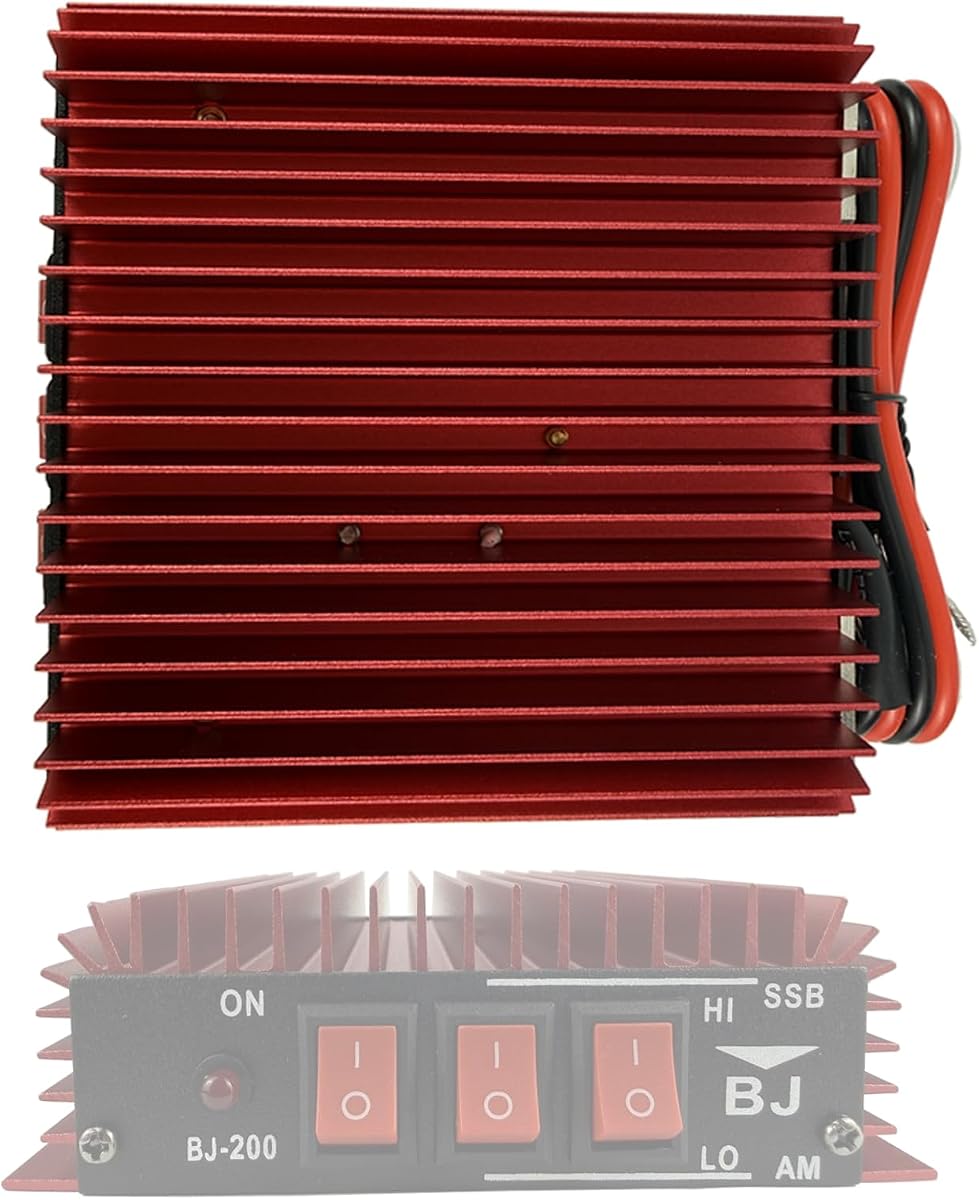
BJ-200 Linear Power AMP
5.0Editor score
150W SSB output max
Compact aluminum heat sink
Simple HI/LO power switch
This comprehensive guide compares the top 10 linear amplifiers for ham radio to help you choose the right model for your HF station setup today.
Linear amplifiers are essential tools for ham radio operators seeking to extend their communication range and signal clarity across various HF bands.
We evaluated ten real products based on output power, band compatibility, protection features, and user feedback to build this reliable comparison list.
Each pick highlights key strengths and trade-offs so you can match an amplifier to your transceiver while noting that market prices fluctuate regularly.
5.0Editor score

4.2Editor score

3.9Editor score
The following table presents a side-by-side overview of all ten models including their core capabilities and intended use cases for HF operation.


The Xiegu GPA100 delivers clean stable RF output up to 100W on HF with a solid state linear design that minimizes distortion for clarity.
We may earn a commission when you buy through this link, at no additional cost to you.
Its flexible band switching allows manual selection or automatic tracking across seven bands which is ideal for operators moving between modes frequently.
Smart cooling and protection detect issues like high SWR or overheating to ensure safe long sessions though unsupported bands may bypass automatically.
This unit is best for those with compatible transceivers like the IC-705 or Xiegu series wanting a reliable upgrade without complex wiring setups.
Built-in Bluetooth enables automatic band switching via the IC-705 removing the need for extra cables in your station setup.
Intelligent control detects high SWR overcurrent and overheating to protect both the amplifier and your connected radio during transmission.
We may earn a commission when you buy through this link, at no additional cost to you.
This amplifier supports multiple modulation modes including AM FM SSB and CW delivering up to 150W SSB output which extends communication range effectively.
We may earn a commission when you buy through this link, at no additional cost to you.
It works with HF transceivers requiring 3-5W input and is compatible with most CB radios and walkie talkies operating in the HF band.
A high-efficiency cooling fan and large aluminum heat sink prevent overheating during extended use while electronic polarity reversal adds safety.
Operators seeking a straightforward upgrade for CB or ham use will find this model practical though build quality may vary compared to premium units.
A high-efficiency cooling fan and large red aluminum heat sink ensure stable operation even during extended use by preventing overheating.
Equipped with electronic polarity reversal protection and dual fuses to safeguard the amplifier from incorrect power connections and surges.
We may earn a commission when you buy through this link, at no additional cost to you.
This alternative variant supports multiple modulation modes including AM FM SSB and CW delivering up to 150W SSB output which extends communication range effectively.
We may earn a commission when you buy through this link, at no additional cost to you.
It works with HF transceivers requiring 3-5W input and is compatible with most CB radios and walkie talkies operating in the HF band.
A high-efficiency cooling fan and large aluminum heat sink prevent overheating during extended use while electronic polarity reversal adds safety.
Operators seeking a straightforward upgrade for CB or ham use will find this model practical though build quality may vary compared to premium units.
A high-efficiency cooling fan and large red aluminum heat sink ensure stable operation even during extended use by preventing overheating.
Equipped with electronic polarity reversal protection and dual fuses to safeguard the amplifier from incorrect power connections and surges.
We may earn a commission when you buy through this link, at no additional cost to you.
This amplifier delivers up to 100W FM 120W AM and 150W SSB output power supporting input power from 3-5W for reliable signal amplification.
We may earn a commission when you buy through this link, at no additional cost to you.
It works with AM FM SSB and CW modes which makes it ideal for radio ham radio and HF transceiver applications across the HF frequency range.
HI/LO power selection switches allow you to adjust output strength based on operating needs while an ON/OFF switch and LED indicator ensure ease of use.
Users looking for a budget-friendly boost for CB or HF operations will find this compact design practical given the lack of advanced tuning features.
Features HI/LO power selection switches to adjust output strength based on operating needs paired with an ON/OFF switch and LED indicator.
Built-in electronic switch and polarity inversion protection safeguard the amp from incorrect power connections ensuring stable and safe operation.
We may earn a commission when you buy through this link, at no additional cost to you.
This model supports AM FM and SSB modes for versatile CB radio use across 3-30MHz frequency range delivering up to 150W SSB output from a 3-5W input.
We may earn a commission when you buy through this link, at no additional cost to you.
It operates on 13.8V DC power supply with 8-11A current draw and features built-in polarity reversal protection to prevent damage from incorrect power connections.
Clear ON/OFF switch HI/LO power adjustment and AM/SSB mode selectors make operation easy while an LED indicator confirms power status reliably.
For enthusiasts wanting a reliable affordable boost for CB or HF stations this rugged compact form factor fits well in vehicle or base station setups.
Operates on 13.8V DC power supply with 8-11A current draw featuring built-in polarity reversal protection to prevent damage from incorrect connections.
Red aluminum alloy heat sink design ensures optimal thermal management during continuous use maintaining stable performance and extending amplifier lifespan.
We may earn a commission when you buy through this link, at no additional cost to you.
The automatic antenna tuner and power amplifier unit can be used independently of each other as either an automatic antenna tuner or a separate power amplifier.
We may earn a commission when you buy through this link, at no additional cost to you.
Its maximum power output is 125 watts which makes it perfect for QRP radios or SDR transceivers with low power consumption when high output is needed.
Intelligent protection circuits ensure safety by entering bypass mode when abnormal operating conditions appear like SWR too high or temperature too high.
Advanced users who want a combined solution will appreciate the large screen display showing input/output power SWR voltage and current clearly at a glance.
The automatic antenna tuner and power amplifier unit can be used independently of each other as either an automatic antenna tuner or a separate power amplifier.
The 2.7 inch large backlit LCD display shows input/output power SWR Voltage Current Temperature amplifier status as well as warning messages.
We may earn a commission when you buy through this link, at no additional cost to you.
This finished board provides ample signal boost for your ham radio transceiver delivering a clean linear power output across the full shortwave spectrum ideal for CW and SSB modes.
We may earn a commission when you buy through this link, at no additional cost to you.
Engineered for high frequency operation from 3MHz to 30MHz it supports both CW and SSB modulation with minimal distortion guaranteeing clear voice and precise morse code transmission.
Advanced broadband circuitry delivers consistent gain across the entire shortwave range without manual tuning using high efficiency transistors and wide bandwidth.
DIY enthusiasts needing a boost for home field day or portable setups will find this module ideal for upgrading QRP transceivers without complex external wiring.
Engineered for high frequency operation from 3MHz to 30MHz covering major amateur radio bands with minimal distortion for clear voice transmission.
Built with an integrated heat sink and low loss PCB material ensuring the power amplifier board can handle extended transmit cycles without overheating.
We may earn a commission when you buy through this link, at no additional cost to you.
This amplifier features a wide DC input compatible with standard automotive or stationary CB power supplies ensuring stable operation during engine start and continuous use.
We may earn a commission when you buy through this link, at no additional cost to you.
It uses a simple three-wire connection utilizing an SO-239 connector which makes installation quick and straightforward for most CB radios and antenna systems.
Designed specifically for CB applications it offers a straightforward solution for users seeking additional signal strength without complex configuration steps.
CB operators looking for a reliable basic power boost will find this unit practical given the simplicity and standard connector compatibility available.
12-14V wide DC input compatible with standard automotive or stationary CB power supplies ensuring stable operation during engine start.
Simple three-wire connection using an SO-239 connector suitable for most CB radios and antenna systems for quick installation.
We may earn a commission when you buy through this link, at no additional cost to you.
This RF amplifier operates from 0.1MHz to 2000MHz covering shortwave FM broadcast VHF/UHF and even 2G/3G/4G signals perfect for ham radio SDR and CB radio.
We may earn a commission when you buy through this link, at no additional cost to you.
With a typical gain of 32dB and a low noise figure it significantly improves weak signal reception with a maximum output of 13dBm at 50 ohm system impedance.
Supports 9V to 12V power supply with only 27mA current consumption making it a portable low noise amplifier for field use or fixed installation with a 12V wall adapter.
For those needing to boost signal reception quality in weak signal environments this wideband amplifier helps increase communication distance and improve clarity effectively.
This RF amplifier operates from 0.1MHz to 2000MHz covering shortwave FM broadcast VHF/UHF and even 2G/3G/4G signals.
With a typical gain of 32dB and a low noise figure this LNA significantly improves weak signal reception for RF receiving front-end applications.
We may earn a commission when you buy through this link, at no additional cost to you.
The XPA125B delivers a maximum output power of 100W in the HF frequency range ensuring robust communication capabilities for any radio enthusiast or professional operator.
We may earn a commission when you buy through this link, at no additional cost to you.
Featuring advanced automatic tuning functionality it simplifies the tuning process allowing users to focus on their communication without manual adjustments during transmission.
This integrated device ensures that maximum output power is automatically maintained and is specifically designed for compatibility with G90 G106 X5105 X6100 X6200 and future XIEGU models.
Enthusiasts using Xiegu transceivers will benefit from the premium quality materials and outstanding support provided by Ham Club Only to ensure a perfect user experience.
Featuring advanced automatic tuning functionality the XPA125B simplifies the tuning process allowing users to focus on their communication without manual adjustments.
Ham Club Only provides Xiegu products with Xiegu professional technicians to provide you with more perfect after-sales service to ensure a perfect user experience.
We may earn a commission when you buy through this link, at no additional cost to you.
Selecting the right amplifier requires understanding power needs power compatibility and build quality to ensure safe effective operation in your station.
Output power determines how much signal boost you get. Look for models that meet your legal and operational requirements while ensuring efficiency and clarity.
Prioritize units offering stable output power across your most used bands.
Ensure the amplifier supports your specific transceiver model and drive level. Mismatched input power can cause distortion or damage to equipment.
Check compatibility with your radio brand and required drive levels before purchasing.
Automatic band switching offers convenience while manual switching provides control. Choose based on how frequently you change bands during sessions.
Auto tracking is ideal for frequent mode changes across HF bands.
Protection circuits like SWR monitoring and thermal shutdown safeguard your equipment. These features prevent damage during adverse operating conditions.
Select units with intelligent protection for safe long-term operation.
Robust heat sinks and fans maintain stable performance under load. Aluminum construction helps dissipate heat efficiently for consistent output.
Look for solid metal casings and active cooling for reliability.
Clear displays and simple controls make operation easier. LCD screens showing SWR and voltage help monitor status during transmissions.
Choose an interface that matches your technical comfort level.
Affordable options exist but quality varies. Set a budget that balances cost with reliability and required features for your station setup.
Invest in units offering best value for long-term use.
Some units integrate with transceivers or offer wireless control. This reduces cabling and enhances convenience for modern stations.
Look for Bluetooth or cable-free setups if possible.
Connect the amplifier to your transceiver and antenna using proper connectors to ensure signal integrity and safety.
Power on the unit and check indicator lights or display for normal status before transmitting any signal.
Monitor temperature and SWR readings during extended use to prevent overheating or impedance mismatches.
A linear amplifier boosts the RF output signal of a transceiver without distorting the modulation. It increases effective communication range while maintaining signal clarity and integrity.
Not all operators need one. If your station requires extra range or power for contests or DX, an amplifier helps. Otherwise, a well-tuned system may suffice.
Most require between 3 to 10 watts of drive. Check your transceiver manual to ensure it can supply sufficient power without overloading output stages.
Legal limits depend on your licensing and local regulations. Ensure operation is within amateur HF bands or other authorized frequencies.
Use built-in protection features like SWR monitoring and cooling. Ensure proper grounding and avoid transmitting without an antenna connected.
Yes, some compact units fit portable setups. Verify power requirements and weight to match your field station needs effectively.
No, amplifiers boost transmit power. For receive improvement, consider a low noise preamplifier designed specifically for incoming signal sensitivity.
Keep vents clean to prevent overheating and check connections periodically. Inspect cables and connectors for wear to ensure safe operation.
The top picks like the Xiegu GPA100 and BJ-200 offer strong performance across different budget and feature levels for HF stations.
Prioritize units matching your transceiver and operational needs to ensure safe efficient amplification for your specific station setup.
Always check current prices and availability as these values fluctuate based on market conditions and regional shipping costs.